Treat an AI control plane like a Tier Zero asset when it can change agent identities, tool permissions, policies, workflows, approval gates, audit behavior, or recovery paths across the enterprise. A compromise there can change what many agents are allowed to do, not merely what one model says.
“Tier Zero” is an executive risk analogy here, not a formal AI-specific classification. Microsoft’s enterprise access model uses Tier 0 for the identity control plane because it can indirectly control the other planes. I would extend that logic to an AI control plane only when its blast radius is comparable. A chatbot interface with no tools and no privileged administration does not automatically qualify.
This control-plane view connects the identity problem created by AI agents, the decision rights required for agentic AI, and the discovery challenge posed by unapproved shadow agents. The common issue is authority: who or what can grant it, change it, observe it, and revoke it?
Define the Asset Before Protecting It
The AI control plane is not one product. It is the set of components that decides how an agent is created, which policy applies, what identity it uses, which tools and data it may reach, when a human must approve an action, what gets logged, and how the workflow is disabled or restored.
Depending on the architecture, that can include:
- the agent registry, orchestrator, and workflow definitions;
- identity issuance, delegation, secrets, and token exchange;
- model and tool routing, allowlists, and policy enforcement points;
- retrieval sources, memory configuration, and data boundaries;
- approval gates for consequential actions;
- evaluation, monitoring, and audit pipelines; and
- deployment, versioning, rollback, revocation, and recovery controls.
Do not label all of this Tier Zero by convenience. Map which components can change enterprise-wide authority or bypass a control. Protect those paths at the highest assurance level. Keep workload-specific administration in a lower plane when it cannot influence the shared control system.
That boundary matters. If every AI component is called critical, the organization will either spend too much protecting low-impact assets or quietly weaken the meaning of the classification.
Why the Analogy Fits
Traditional workloads usually execute logic that engineers defined in advance. An agent may select among tools and actions at runtime. The model is not the final enforcement point, but the system around it can translate model output into API calls, code changes, financial actions, identity changes, or access to sensitive data.
NIST’s Zero Trust Architecture describes the policy engine and policy administrator as key enterprise components because resource communication depends on their decisions. It warns that configuration changes to those components must be logged and audited, and that disruption can affect enterprise operations. An AI platform that centralizes permission, policy, and tool-routing decisions deserves the same architectural attention.
The threat set is broader than prompt injection. OWASP’s 2026 Top 10 for Agentic Applications includes agent goal hijacking, tool misuse, identity and privilege abuse, unexpected code execution, insecure inter-agent communication, and rogue agents. Those risks do not all originate in the control plane, but a weak control plane can amplify them across workflows.
Keep Authority Outside the Model
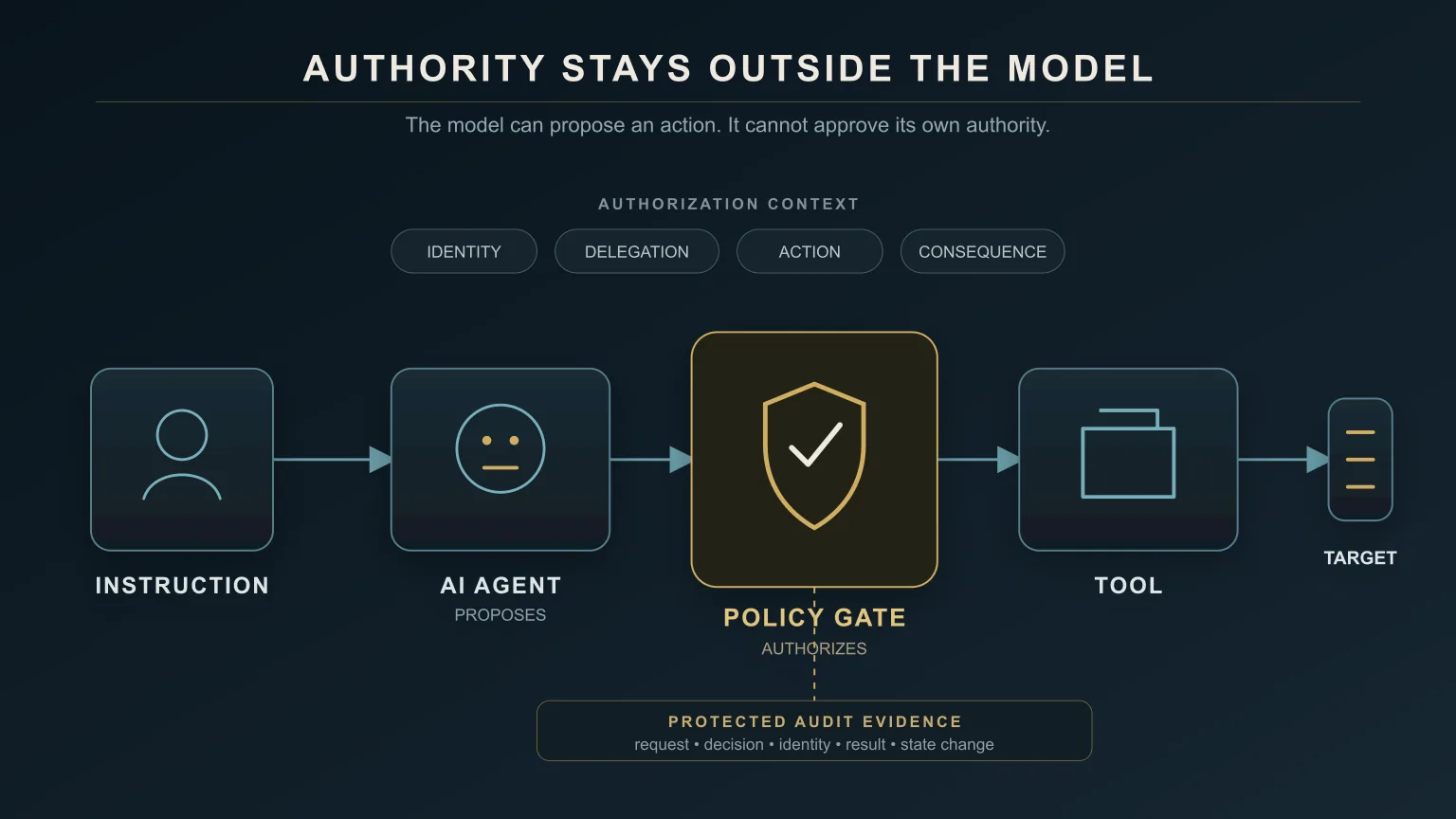
The first design rule is simple: the model may propose an action, but deterministic policy should authorize the concrete operation. Do not ask the model whether its own request is safe and treat the answer as access control.
Evaluate the actual principal, delegated user or service context, target resource, action, data classification, workflow state, and consequence. A request to read a public document is different from a request to change a payment destination, even when both arrive through the same agent.
Use distinct workload identities rather than a shared service account or a sponsoring person’s long-lived credential. Scope access to the task and resource, and make credential lifetime appropriate to the action. The six identity design tests for AI agents provide a practical starting point for sponsorship, bounded delegation, provenance, and lifecycle control.
This area is still maturing. In February 2026, the NIST National Cybersecurity Center of Excellence published a concept paper focused on applying identification, authorization, auditing, and non-repudiation practices to software and AI agents. That is a useful signal to apply established identity principles now without pretending every agent-specific standard has already settled.
Protect the Administrative Path
A control plane should not be administered from the same everyday path used for email, browsing, and general productivity. Separate privileged administration, require strong authentication, use time-bound elevation, and monitor both the administrator and the device state.
Control-plane changes need version history, peer review proportionate to consequence, and an auditable link from request to deployment. Protect policy repositories, agent registries, tool catalogs, secrets, and logging configuration from unilateral or unobserved changes. A platform administrator who can change permissions and erase the evidence is part of the highest-risk path, regardless of job title.
Also look for indirect control. A build system, backup service, deployment credential, monitoring agent, or plugin marketplace may inherit the control plane’s sensitivity if it can replace policy, alter agent packages, restore unsafe configuration, or run with equivalent privilege.
Design Revocation Before Autonomy
Revocation must work at the level where authority is exercised. Disabling a chat window is not enough if scheduled workflows, cached credentials, queued tool calls, or secondary agents can continue.
For each consequential workflow, test whether the organization can:
- disable one agent without stopping every agent;
- revoke active credentials and delegated access;
- block a tool or action class centrally;
- stop queued and in-flight work where the target allows it;
- preserve evidence for investigation;
- move to a safe manual or read-only mode; and
- restore a known-good policy and workflow version.
Not every external action can be undone. A sent payment, deleted record, or disclosed secret may be irreversible. That is why approval gates should follow consequence rather than novelty. High-impact financial, identity, production, customer-data, and regulated decisions may require a human or a separately controlled verification step even when low-impact actions remain autonomous.
Build One Trace Across the System
Agent evidence is often scattered across the user interface, model gateway, orchestrator, identity provider, policy engine, tool, and target application. Give the workflow a correlation identifier and preserve enough context to reconstruct the instruction, agent identity, delegated authority, authorization decision, tool request, result, and resulting state change.
The goal is not to capture private model reasoning or dump sensitive prompts into every log. The goal is to answer operational questions: What initiated the action? Which principal performed it? Which policy allowed it? What changed? Can the access be revoked? Who owns recovery?
Logging also has to survive the incident it is meant to explain. If the same control plane can silently rewrite both policy and audit history, the evidence path is not independent enough for the risk.
Ask for Control Evidence, Not a Product Label
An executive review can use five questions:
| Question | Evidence to request |
|---|---|
| What can this control plane change? | A map of identities, policies, tools, data, workflows, and downstream systems |
| Who can administer it? | Named roles, privileged access paths, elevation rules, and recent access review |
| Where is authorization enforced? | A tool-call path showing policy outside the model and deny behavior |
| How fast can authority be revoked? | Results from an agent, token, tool, and workflow shutdown exercise |
| Can we recover and investigate? | A tested restore path plus correlated, protected audit evidence |
Start with the workflow that has the greatest authority over money, identities, production, customer data, or regulated decisions. Trace it from instruction through policy and tool execution to recovery. The gaps will show whether the next investment belongs in identity, isolation, policy enforcement, observability, or resilience.
The control plane becomes Tier Zero because of what it can control. Protect it according to that authority, and keep the classification narrow enough to remain meaningful.