
The important line is not between old software and new software. It is between software that recommends an action and software that can take one. Once an AI system can plan, invoke tools, change records, or trigger a workflow, an application review by itself is no longer enough. The enterprise also needs decision rights, supervision, exception handling, and operational ownership for the action loop.
OWASP’s February 2025 agentic threat work is an early signal of that shift. The concern is broader than prompt injection or data leakage because an agent may combine instructions, data, credentials, and tools to produce an operational effect. Existing application security still matters, but it does not answer who approved the action or what should happen when the agent reaches an unfamiliar exception.
A workable model builds on platform engineering’s supported paths, the infrastructure behind enterprise AI, and a disciplined approach to cloud uncertainty and guardrails.
From Answering to Acting
To understand the scope of this change, you must distinguish between a chatbot and an agent. A chatbot answers; it stops when the conversation ends or the prompt concludes. An agent plans; it initiates sequences, utilizes external tools, consumes data, performs actions, and handles exceptions independently. This capability transforms IT from a support function into an active participant in business operations.
When an application simply retrieves information, the human remains the primary decision-maker throughout the loop. The risk is contained within the boundaries of the user’s intent. When an agent acts on that intent, ordering inventory, negotiating contracts, or automating compliance checks, the human steps back from the immediate control plane. This creates a gap where traditional governance fails because there is no human in the loop to catch errors in real time.
NIST’s July 2024 Generative AI Profile applies Govern, Map, Measure, and Manage across the lifecycle. For an agentic system, that work has to include delegated authority, tool access, approvals, monitoring, and recovery. The business still needs a named owner when software acts incorrectly or exceeds its intended boundary.
The Autonomy Loop and Decision Rights
An autonomous agent operates through a specific loop: it identifies an intent, selects tools, consumes data, executes actions, and manages exceptions. At each stage, there is a potential point of failure that requires human oversight. If the system assumes human judgment is available on demand, it will eventually fail because humans cannot respond instantly to every anomaly.
This creates a necessity for new decision rights structures. We need clear definitions of which decisions can be made autonomously and which require human approval. This often leads to the concept of autonomy tiers. Tier one might allow an agent to perform low-stakes tasks like scheduling meetings or formatting documents with zero human intervention. Tier two could permit actions up to a certain monetary threshold or risk level, requiring pre-approval but allowing post-action execution. Tier three involves high-impact decisions that require real-time human escalation before the action is taken.
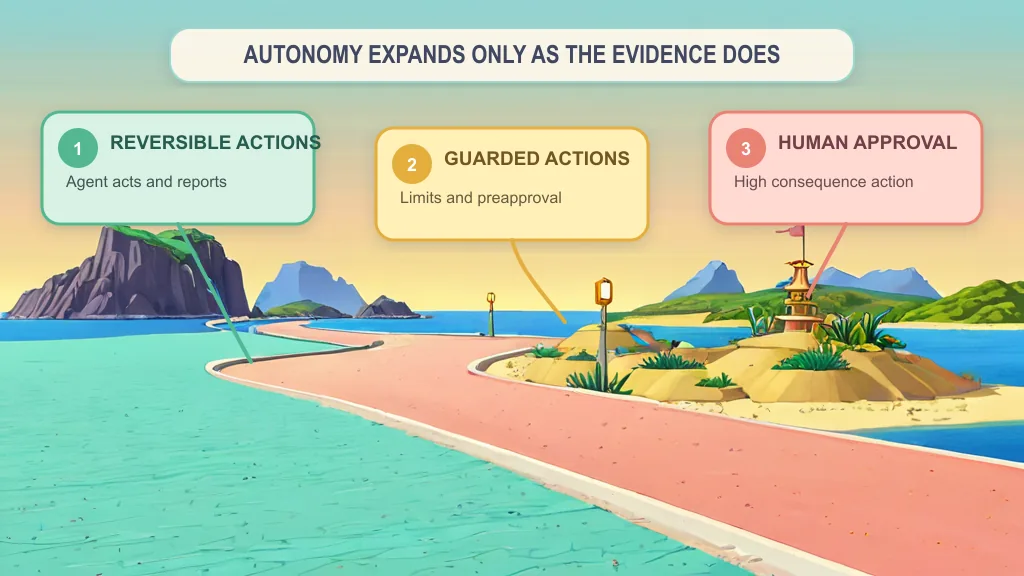
These tiers make the tradeoff discussable. Too much authority can expose data, spend money, or change a business system without an adequate recovery path. Too little may leave an expensive workflow that adds no advantage over ordinary automation. The appropriate boundary depends on consequence, reversibility, and the quality of the evidence available at the moment of action.
Supervision and Exception Handling
The most critical aspect of an agentic operating model is how exceptions are handled. In traditional systems, an error message stops the process or alerts a human administrator. In an agentic environment, an exception might be a failed transaction, a policy violation detected mid-stream, or a data inconsistency that breaks the planned workflow.
Supervision in this context means designing for the unexpected. You must build robust feedback loops where agents can self-correct, log detailed audit trails, and escalate specific patterns of failure to humans rather than reacting to every single error individually. The human’s role shifts from performing tasks to reviewing aggregated reports on agent performance and intervening only when the system encounters a novel type of failure or exceeds its defined risk parameters.
Effective exception handling requires moving beyond reactive support to proactive governance. This involves setting clear boundaries on what an agent can do, monitoring for drift in behavior, and ensuring that every action taken is traceable. If an agent acts outside its mandate, the organization must know immediately who was responsible and how to remediate the situation.
Redesigning Organizational Accountability
You cannot simply add AI features to your existing organizational structure; you must redesign accountability around the new operational loop. When a human executes a task, they are personally accountable for the outcome. When an agent executes a task, the question becomes who is accountable when the agent fails? Is it the person who programmed the agent, the manager who deployed it, or the enterprise that owns the infrastructure?
Organizational accountability must be explicit about these roles. A pilot may sit in one division, but its identity, data, security, and incident decisions affect the enterprise. The operating model should therefore make local speed possible without letting one team’s success create risks or costs that everyone else inherits.
This requires a shift in how we measure performance. Instead of measuring individual agent uptime or response time, leadership must track business outcomes, meaningful risk reduction, and improved customer operations. Technology should produce business outcomes, reduce meaningful risk, improve capability, improve customer outcomes, or improve operations. If an agentic system improves efficiency but increases the frequency of compliance errors, it has failed its primary purpose despite its technical success.
Bounded Curiosity Needs a Safe Place to Fail
Blanket prohibition tends to move experimentation out of sight. Unbounded autonomy creates the opposite problem. A better starting point is a sandbox with synthetic or low-sensitivity data, narrow permissions, observable tool calls, and an explicit human escalation path. Teams can learn what the agent does well without placing a critical business process inside the blast radius.
That is also a people decision. If leaders want teams to test agentic workflows, they should fund the test environment, define what failure is acceptable, and participate in the review of what was learned. Curiosity works when the boundary is credible and a reported failure becomes evidence rather than a career hazard.
Practical Steps for Leadership
To move forward, leaders should focus on three concrete areas: defining autonomy tiers, establishing a human escalation model, and clarifying organizational accountability. Start by mapping current processes to identify which ones are ripe for agent execution based on clear rules and low risk. Then, design the governance layer that allows these agents to operate safely within those boundaries. Finally, ensure that the organization’s leadership structure supports this new reality by redefining how success is measured and how failures are addressed.
The operating model should expand only as the evidence does. Start with reversible actions, prove the supervision and escalation path, and increase autonomy when the business outcome and control evidence justify it.