
AI literacy works as an enterprise control when it is tied to the decisions a person is allowed to make. Buyers, builders, users, reviewers, and executives do not need the same course because they do not create the same risk.
The Control Competence Framework
As of July 2025, Article 4 of the EU AI Act requires providers and deployers to take measures for a sufficient level of AI literacy, considering knowledge, experience, education, training, and the context of use. A generic training record can document attendance. It cannot show that someone can make the right decision when a vendor claim, model output, or escalation path is ambiguous.
Role-specific literacy supports the minimum viable AI governance model, the new decision rights around agentic AI, and the people-centered lessons in building a productive hybrid operating model.
Control competence means applying judgment in a realistic scenario. A buyer needs to challenge claims and data terms before contracting. A builder needs to test known limitations and fallback behavior. The useful question is not only “did you complete the course?” It is “can you make the decision your role requires?”
Mapping Roles to Decisions
To make literacy actionable, we must define the five key audiences and the specific decisions each must make. This creates a role-based literacy matrix that maps competence directly to authority.
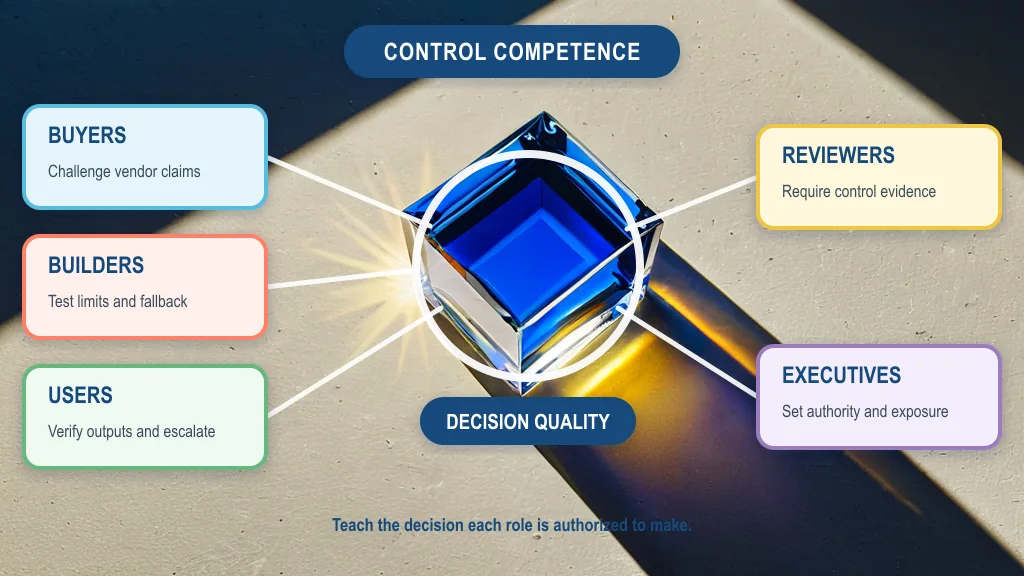
- Buyers must decide on model suitability, cost-benefit ratios, and data provenance before signing contracts. They need to know if a vendor’s claims match reality.
- Builders must decide on integration points, testing protocols, and fallback mechanisms during the engineering phase. Their focus is on stability and edge cases.
- Users must decide how to interact with the system, when to override suggestions, and how to report anomalies. They need awareness of hallucination risks.
- Reviewers must decide on compliance checks, audit trails, and ethical alignment before deployment. They act as the gatekeepers for policy adherence.
- Executives decide on strategic risk exposure, resource allocation, and public communication. They also resolve conflicts between divisional goals and enterprise risk.
Each role has a different decision set. Builders need enough policy context to recognize when specialist review is required; they are not expected to become compliance counsel. Executives need enough technical fluency to understand uncertainty, authority, and operating cost. The matrix tests judgment in the decisions a role actually makes.
Evidence Over Certificates
A major constraint is the lack of useful evidence for literacy. Attendance sheets and quiz scores say little about judgment. The NIST AI RMF Playbook places roles, documentation, and training-related actions inside a broader governance system. The practical opportunity is to connect that work to the decisions people actually make.
Literacy evidence should come from relevant behavior, not attendance alone. A short scenario can ask an employee to identify sensitive data before using a tool, a buyer to challenge a supplier claim, or an executive to respond when an agent exceeds its authority. The purpose is to find gaps and improve the control, not to turn training into employee surveillance.
Measurement should focus on decision quality, not learning completion. We can track whether systems are deployed correctly, whether incidents occur due to human error in judgment, and whether teams self-correct when things go wrong. This approach reduces fear because it focuses on improvement rather than punishment. It encourages curiosity about why a system behaved unexpectedly rather than hiding behind a lack of knowledge.
Practice Beats Awareness Theater
Use short exercises built around real work: compare two vendor disclosures, investigate a suspect output, choose whether data can be entered into a tool, or decide when a human must take over. Let people explain their reasoning. A missed question becomes a useful signal about the control or training, not an excuse for public scorekeeping.
This approach treats people as participants in the control system rather than its weakest-link slogan. It also gives leaders evidence about where a process is confusing, a tool makes the safe path difficult, or an escalation route is not trusted.
Executive Implications for Governance
The standard should be enterprise-wide, but the training should not be generic. Procurement needs to recognize unsupported claims in a vendor response. HR needs to understand when an AI-assisted employment decision raises a different level of risk. Engineers need to test failure modes and escalation paths. Executives need enough fluency to ask whether the control evidence matches the authority granted to the system.
Documenting how teams apply their knowledge creates evidence for internal governance and can support compliance work. It does not prove compliance by itself. The evidence should be proportionate to the role and the risk of the decision.
Furthermore, this model supports a pragmatic view of technology economics. Investing in role-specific literacy is not an expense; it is an investment in reducing downstream costs from errors, delays, and reputational damage. It improves operations and customer outcomes by ensuring that AI systems are used correctly and safely.
Start with One Decision Per Role
Pick the most consequential recurring AI decision made by each audience. Define what a competent decision looks like, give people a realistic exercise, and record where the process breaks down. That is a better first control than assigning the same hour-long module to everyone and calling the enterprise literate.