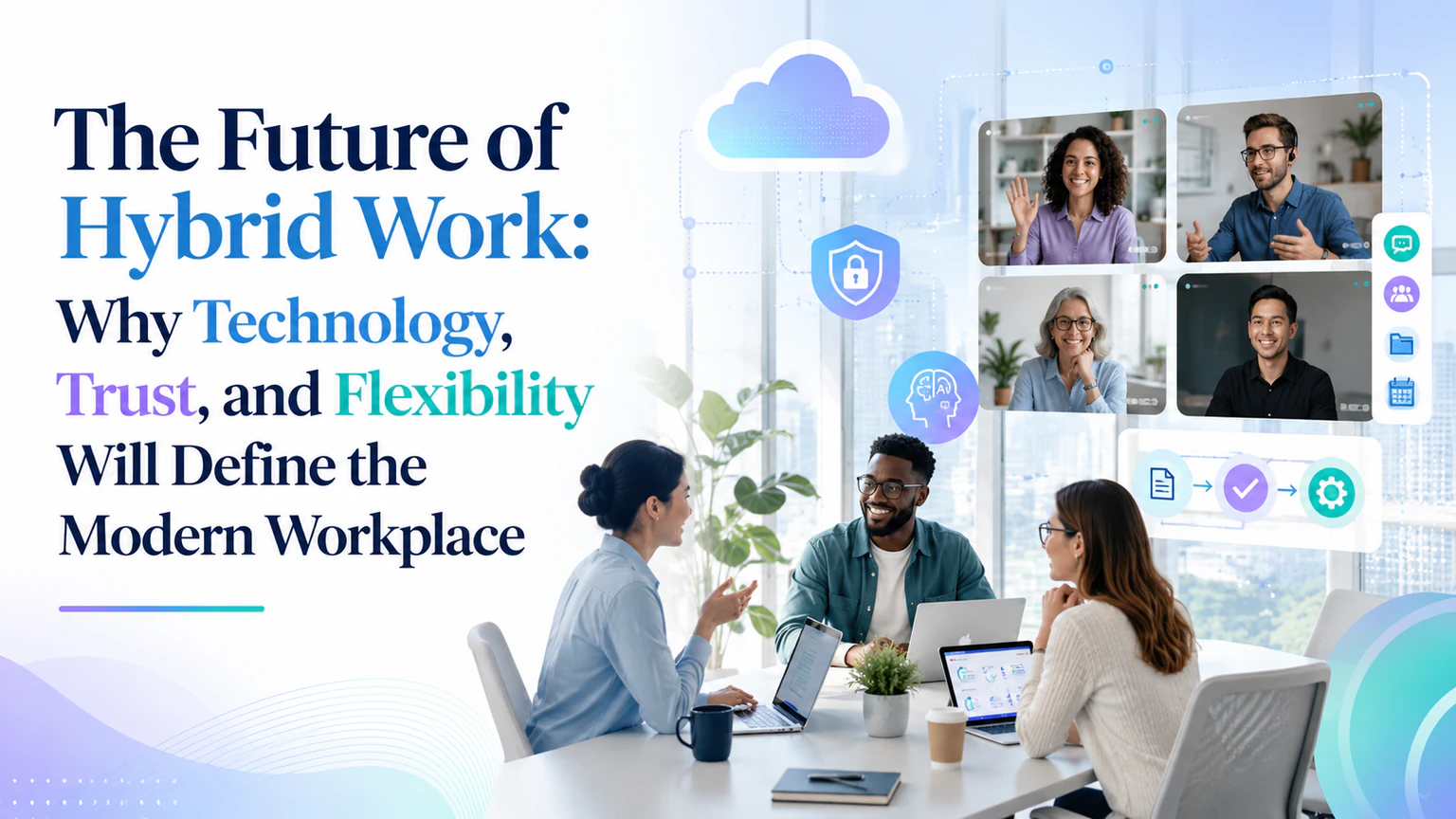
Hybrid work succeeds when organizations treat it as an operating model built on clear outcomes, secure access, reliable digital tools, intentional collaboration, and trust—not as a weekly attendance formula. The goal is to help people do their best work from the location that fits the task while preserving connection, resilience, and accountability.
In 2020, organizations adopted remote work because they had to. In 2021 and 2022, many business leaders tried to determine whether employees should remain remote, return to the office, or follow some combination of the two.
By 2023, that debate is becoming outdated.
The real question is not where employees should work. It is how organizations can build a secure, productive, collaborative, and resilient operating model that allows people to do their best work from almost anywhere.
After more than 20 years leading technology organizations, I have seen plenty of workplace trends come and go. Hybrid work feels different because it is not simply an HR policy or an employee benefit. It represents a fundamental change in how companies manage people, technology, information, security, and business performance.
Organizations that treat hybrid work as a temporary scheduling issue will struggle. Organizations that treat it as a digital transformation strategy can create a serious competitive advantage.
Hybrid Work Is a Business Strategy, Not a Location Policy
A hybrid workplace cannot be defined by requiring employees to spend an arbitrary number of days in an office.
That is attendance management, not business transformation.
A successful hybrid work strategy starts with the work itself. Leaders must consider what employees are trying to accomplish, what resources they need, how teams collaborate, how performance is measured, and where specific activities are most effective.
Some work benefits from people being together. Strategic planning, relationship building, creative workshops, onboarding, and difficult conversations may be more productive in person.
Other work requires concentration, autonomy, and uninterrupted time. Forcing employees to commute to an office only to spend the day participating in virtual meetings does not automatically improve productivity or collaboration.
The best hybrid model will not be identical for every company, department, or employee. It should reflect the organization’s customers, culture, security requirements, operational needs, and business objectives.
The goal is not to make everyone happy every minute. The goal is to build an operating model that produces better outcomes.
Trust Is Becoming a Core Enterprise Technology
For decades, many organizations associated visibility with productivity. If a manager could see an employee sitting at a desk, the assumption was that work was getting done.
We now know that physical presence is a poor performance metric.
An employee can sit in an office for eight hours and accomplish very little. Another employee can complete important, high-quality work in a fraction of that time from a home office, customer site, airport, or coffee shop.
Hybrid work forces leaders to move away from managing activity and toward managing outcomes.
That means establishing clear expectations, measurable goals, defined ownership, transparent deadlines, and shared accountability. Employees should understand what success looks like without needing a manager to monitor every hour of their day.
This transition can be uncomfortable for leaders who built their management style around control. However, trust does not mean abandoning oversight. It means replacing outdated supervision with better data, better communication, and better leadership.
Trust employees to execute, but give them clear objectives and the technology required to succeed.
The Digital Employee Experience Is Now the Workplace
For a hybrid employee, the workplace is no longer a building.
The workplace is the complete digital experience an employee encounters while trying to perform a job.
It includes the laptop, internet connection, applications, identity platform, collaboration tools, security controls, cloud services, help desk, data access, and business processes surrounding that employee.
When those systems work together, employees can focus on customers, innovation, and results.
When they do not, every task becomes harder than it should be.
An employee who needs multiple passwords, three approval processes, two virtual private network connections, and a support ticket just to access a basic application is not experiencing a productivity problem. That employee is experiencing an IT architecture problem.
Technology leaders must start evaluating employee technology with the same intensity that businesses evaluate the customer experience.
How quickly can a new employee become productive? How easily can someone find information? Can employees securely access applications from different locations? Can they solve routine technical problems without waiting for the help desk? Do collaboration tools simplify work, or create more interruptions?
These are no longer minor IT questions. They directly affect employee retention, business productivity, customer satisfaction, and revenue.

Cloud Computing Is the Foundation of Hybrid Work
Hybrid work depends on secure and reliable access to applications and data.
That makes cloud computing, software-as-a-service platforms, virtual desktops, automation, and modern identity management essential parts of the digital workplace.
The objective is not to move every workload into a public cloud simply because cloud technology is popular. The objective is to place applications and data in environments that provide the right balance of performance, cost, availability, security, compliance, and user experience. As I discuss in my guide to managing cloud uncertainty, placement decisions need to balance performance, cost, resilience, security, and control.
For some organizations, that will mean public cloud services. Others will continue operating private cloud, traditional data centers, edge locations, and specialized infrastructure. Most enterprises will use a combination.
Employees should not need to understand where an application is hosted. They should simply be able to access the right resources securely and consistently.
The infrastructure may be complex behind the scenes, but the employee experience should feel simple.
That is the real promise of enterprise cloud technology.
Cybersecurity Must Follow the User
Traditional security models were often built around a corporate network with a clearly defined perimeter. Employees worked inside an office, connected to company-owned infrastructure, and accessed centrally managed applications.
Hybrid work changes that model.
Employees may connect from home networks, hotels, airports, customer locations, mobile devices, and shared workspaces. Applications may operate across multiple cloud providers, software platforms, and data centers.
Security can no longer depend on whether someone is sitting inside a company building.
Organizations must verify identity, device health, access rights, application permissions, and data sensitivity wherever the employee is working. Multifactor authentication, identity-based access, endpoint protection, encryption, data governance, continuous monitoring, and zero-trust security principles are becoming foundational business requirements. That visibility depends on an infrastructure monitoring practice that turns signals into decisions, not simply another collection of dashboards.
However, security must also be usable.
When security controls make legitimate work unnecessarily difficult, employees often search for shortcuts. That can lead to personal file-sharing accounts, unauthorized applications, copied data, weak passwords, and other forms of shadow IT.
The strongest cybersecurity strategy is not simply restrictive. It makes the secure path the easiest path.
Collaboration Requires More Than Video Meetings
One of the biggest mistakes organizations made during the rapid transition to remote work was attempting to recreate every office interaction through a video call.
That approach produced crowded calendars, meeting fatigue, constant interruptions, and endless context switching.
Video conferencing remains valuable, but it should not become the default solution for every business problem.
Modern collaboration requires a combination of real-time and asynchronous communication.
Real-time collaboration is useful when teams need immediate discussion, rapid decisions, brainstorming, or personal connection.
Asynchronous collaboration gives employees time to think, review information, document ideas, and contribute across different schedules and time zones. It can also create opportunities for people who may not be the loudest voices in a conference room but have valuable expertise and perspectives.
The objective should be to reduce the number of meetings while improving the quality of communication.
Before scheduling another call, teams should ask whether the desired outcome could be accomplished through a shared document, project-management platform, recorded update, knowledge base, or clearly written decision request.
A meeting should have a purpose, an owner, and an expected outcome. Otherwise, it is probably just stealing time from actual work.
Hybrid Work Can Expand the Talent Market
When every employee must live within commuting distance of a company office, the organization is recruiting from a limited geographic area.
Hybrid and remote work can dramatically expand that talent pool.
Companies can reach skilled professionals who live in different cities, care for family members, have disabilities, cannot relocate, or simply perform better outside a traditional office environment.
That expanded access can create a workforce with a broader range of backgrounds, experiences, and ideas.
Diversity does not automatically produce innovation. Leaders must also build an environment where employees feel safe contributing ideas, challenging assumptions, and respectfully disagreeing with one another.
Hiring diverse talent without creating an inclusive culture will not deliver the desired result.
The competitive advantage comes from combining access to talent with psychological safety, strong leadership, clear communication, and meaningful opportunities to contribute.
Artificial Intelligence Will Reshape the Digital Workplace
In 2023, generative artificial intelligence is beginning to move from technology demonstrations into everyday business conversations.
AI has the potential to become an important part of hybrid work by helping employees summarize information, draft communications, automate repetitive tasks, locate organizational knowledge, analyze data, and receive faster answers to common questions. The same opportunity is already visible in how AI is reshaping DevOps practices, where assistance and automation can reduce toil without removing human judgment.
Imagine an employee being able to ask a secure internal assistant how to complete a process, locate a policy, troubleshoot an application, or prepare for a customer meeting without searching through dozens of documents.
That could significantly improve productivity.
It also introduces serious questions involving data privacy, intellectual property, accuracy, security, regulatory compliance, and responsible use.
Companies should not ignore AI, but they should not allow uncontrolled adoption either. Technology and business leaders need to begin establishing policies, approved platforms, data protections, employee training, and practical use cases.
The organizations that approach AI thoughtfully may create a major productivity advantage. Those that prohibit it without offering alternatives may simply push its use underground.
Automation Should Remove Friction from Work
Employees should not need to open a help desk ticket for every routine request.
Password resets, software access, equipment requests, application provisioning, common troubleshooting, and basic workflow approvals can increasingly be handled through secure self-service automation.
This does more than reduce support costs.
It allows employees to solve problems when they occur instead of waiting for another department. It also gives IT teams more time to focus on security, architecture, reliability, automation, and strategic business initiatives.
The best automation is often invisible. Employees do not care which platform completed the request. They care that the process was fast, reliable, and easy.
Every repetitive manual process should be evaluated as a candidate for improvement.
If employees repeatedly copy information between systems, wait days for simple approvals, or rely on tribal knowledge to complete routine tasks, the organization has an automation opportunity.
Leaders Must Protect Employees from Digital Overload
Hybrid work creates flexibility, but it can also blur the boundaries between professional and personal life.
Employees may feel pressure to remain available throughout the day, respond immediately to messages, attend meetings across multiple time zones, and monitor several communication platforms at once.
That is not sustainable productivity.
Leaders should create clear communication norms. Teams need to understand which channels are appropriate for emergencies, routine questions, project updates, and decisions. Employees should also know when they are expected to be available and when delayed responses are acceptable.
Focused work must be protected.
A calendar filled with meetings can create the appearance of collaboration while preventing people from completing the work those meetings generated.
Strong hybrid leadership means managing energy and attention, not just schedules.
The Office Still Matters, but Its Purpose Is Changing
The office is not disappearing. Its role is evolving.
Instead of being the default location where every employee completes every task, the office can become a destination for collaboration, mentoring, training, customer engagement, social connection, and complex teamwork.
That requires organizations to rethink office design.
Rows of assigned desks may be less valuable than flexible collaboration areas, quiet rooms, high-quality meeting technology, training spaces, and places where distributed teams can interact equally.
Remote participants should not feel like secondary attendees watching a conversation happen somewhere else.
Meeting rooms need better cameras, microphones, displays, room controls, and collaboration software. More importantly, meeting leaders must deliberately include everyone, regardless of location.
Technology can support inclusion, but leadership behavior ultimately determines whether it happens.
How Organizations Can Build a Better Hybrid Workplace
There is no universal hybrid work formula, but every organization should address several foundational priorities:
1. Define success through outcomes
Establish measurable business goals instead of relying on attendance, activity, or online-status indicators.
2. Design policies around the work
Determine when physical presence creates value and when remote work enables better focus or flexibility.
3. Modernize the employee technology experience
Simplify access to applications, data, support, collaboration tools, and business processes.
4. Strengthen identity and cybersecurity
Protect users, devices, applications, and information regardless of location.
5. Reduce unnecessary meetings
Use asynchronous tools and documented communication whenever real-time interaction is not required.
6. Automate repetitive processes
Give employees secure self-service options and remove avoidable administrative friction.
7. Train managers to lead distributed teams
Hybrid leadership requires communication, empathy, accountability, inclusion, and comfort managing by outcomes.
8. Measure and continuously improve
Review productivity, employee experience, security incidents, customer outcomes, retention, and technology performance. Adjust the model based on evidence rather than executive preference.
The Future of Hybrid Work Is Already Here
Hybrid work is not about choosing between the office and the kitchen table.
It is about creating an organization that can operate effectively across locations, devices, applications, teams, and time zones.
The companies that succeed will not be the ones with the strictest attendance policy or the largest collection of collaboration tools. They will be the organizations that combine clear business objectives with trusted employees, capable leaders, secure technology, intelligent automation, and a culture focused on results.
That is the real future of work.
It is more flexible, more digital, more distributed, and potentially more productive than anything we have built before.
But technology alone will not make it successful.
The winning formula will be technology that empowers people, leadership that creates clarity, and a culture that measures what employees accomplish—not where they happen to be sitting when they accomplish it.
Frequently Asked Questions About Hybrid Work
What is hybrid work?
Hybrid work is an operating model that allows employees to perform their responsibilities from a combination of company offices, home offices, customer locations, and other approved environments. The specific arrangement depends on the employee’s role, team, and business requirements.
What technology is needed for hybrid work?
Most hybrid organizations need secure identity management, cloud-based applications, collaboration platforms, endpoint security, device management, reliable connectivity, data protection, automation, and remote IT support. Some businesses may also use virtual desktop infrastructure or desktop-as-a-service technology.
Does hybrid work improve productivity?
Hybrid work can improve productivity when employees have clear goals, appropriate technology, effective leadership, and flexibility that matches the work being performed. Poorly designed hybrid policies can create additional meetings, communication gaps, security risks, and employee frustration.
What is the biggest challenge of hybrid work?
The biggest challenge is usually not technology. It is changing leadership and management practices from supervising employee activity to measuring business outcomes.
How does cybersecurity support hybrid work?
Cybersecurity protects employee identities, devices, applications, and company data outside the traditional office network. Strong hybrid security typically includes multifactor authentication, endpoint protection, encryption, access controls, monitoring, and zero-trust security practices.