In March 2025, AI’s practical role in DevOps is narrower—and more useful—than the headlines suggest. It can explain unfamiliar code, draft tests and runbooks, summarize noisy operational data, and help an engineer reach a decision faster. It is not a substitute for small changes, reliable tests, observable services, clear ownership, or a safe rollback path.
That distinction matters because AI is a force multiplier. Put it inside a disciplined delivery system and it can reduce toil. Put it on top of fragmented pipelines and weak controls and it can help a team create mistakes faster.
I have built platform engineering teams at AdvancedMD and Nymbus, where healthcare and financial technology made the tradeoff between speed and control very real. The durable lesson was not that teams needed more tools. They needed a supported path from code to production, with security, observability, and recovery built into it. AI does not change that lesson. It raises the value of getting the path right.
The 2025 evidence is promising, but not simple
The most useful reality check comes from the 2024 DORA research. More than 75 percent of respondents said they used AI for at least one daily professional responsibility. A 25 percent increase in AI adoption was associated with better documentation quality, code quality, and code review speed.
Those local improvements did not automatically produce a better delivery system. The same increase in AI adoption was associated with an estimated 1.5 percent decrease in delivery throughput and a 7.2 percent reduction in delivery stability. DORA also reported that 39 percent of respondents had little or no trust in AI-generated code.
These are associations, not proof that AI caused the changes. They still expose the central operating problem: making one step faster can increase pressure on every step after it. More generated code means more code to understand, test, review, secure, deploy, and support. If those downstream controls are already weak, AI finds the weakness quickly.
That is why pull-request volume, accepted suggestions, and licenses assigned are incomplete measures. The scorecard still needs delivery and reliability outcomes: lead time for changes, deployment frequency, change failure rate, recovery time, service-level objectives, and rework.
Start where AI can assist without taking control
The best early use cases share three traits: the work is time-consuming, the output is easy for a qualified person to verify, and a bad answer cannot directly change production.
Explain, draft, and review before the merge
Code assistants are useful for explaining a legacy function, drafting a unit test, converting a configuration example, documenting an API, or identifying areas that deserve closer review. This is especially valuable when the task is bounded and the engineer already knows what a correct answer should look like.
A 2024 GitHub and Accenture study found higher pull-request activity and strong developer adoption among participants using GitHub Copilot. That is encouraging evidence for a controlled pilot, but it is not a universal business case. GitHub participated in the research, and more pull requests do not by themselves establish better customer outcomes or safer production changes.
The operating rule is simple: AI may prepare a change, but the same engineering standards still accept or reject it. The author must understand the code. Automated tests, security checks, peer review, and repository policy remain authoritative.
Reduce investigation time inside CI/CD
Build and test systems generate large amounts of repetitive evidence. AI can summarize a failed pipeline, group similar errors, suggest which component changed, draft a test case from an acceptance criterion, or point a reviewer toward a high-risk section of a diff.
Keep deterministic controls in charge. A model can explain why a dependency scan failed; it should not quietly waive the result. It can propose a test; it should not decide that the test suite is unnecessary. It can summarize a policy violation; the policy engine should still block the release.
This separation gives teams the speed of probabilistic assistance without turning a plausible answer into an approval mechanism.
Turn incident data into a faster first hypothesis
During an incident, the expensive part is often not a lack of data. It is the time required to connect alerts, deployment events, logs, traces, ownership records, and runbooks into a coherent starting point.
AI can help assemble a timeline, summarize recent changes, translate a query, retrieve the relevant runbook, and propose hypotheses for an engineer to test. It works best when the underlying monitoring strategy starts with business outcomes and clear service signals. Without good telemetry and ownership metadata, an AI-generated incident summary is simply a confident interpretation of incomplete evidence.
The incident commander remains accountable for the decision. Early automation should be read-only. The next level can recommend a reversible action and wait for approval. Fully automatic remediation belongs only in a narrow, well-tested domain with rate limits, audit logs, health checks, and a proven rollback.

AI needs a platform, not a pile of integrations
Most enterprises already have enough DevOps tools. The harder problem is that repositories, pipelines, deployment systems, service catalogs, security scanners, telemetry, tickets, and runbooks often disagree about the state of the same service.
An AI assistant placed across that fragmented environment does not create a source of truth. It creates another interface to the fragmentation.
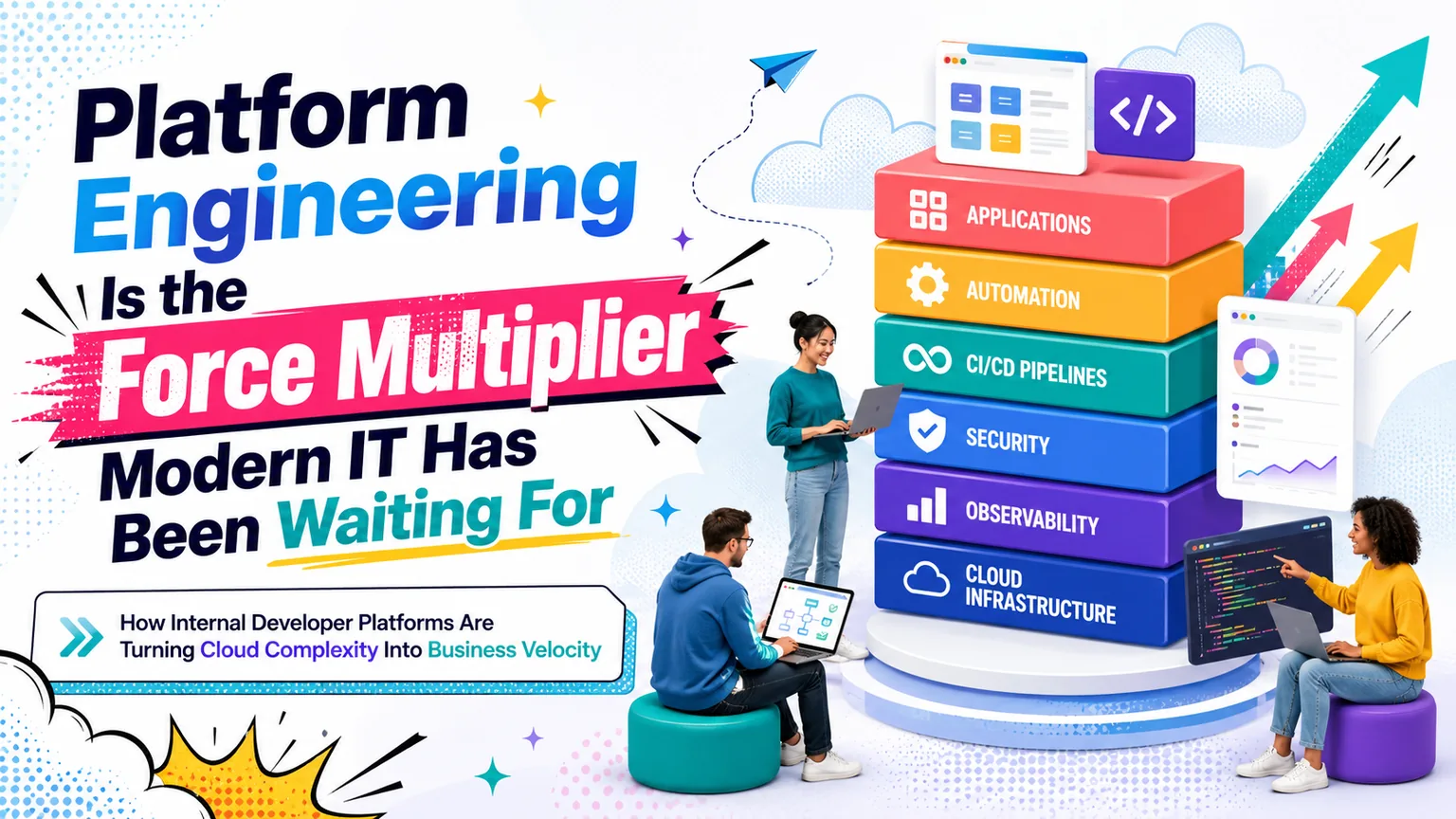
This is where platform engineering becomes the practical foundation. A supported developer path gives AI consistent context: approved templates, named service owners, standard deployment events, policy results, rollback procedures, and observable production behavior. Developers get assistance inside a workflow they already trust instead of another portal they must reconcile with reality.
The same principle applies to security. NIST’s Generative AI Profile treats risk management as lifecycle work, while its Secure Software Development Framework profile for generative AI extends secure-development practices to organizations that produce or acquire AI systems. For a DevOps leader, that translates into practical questions:
- What source code, logs, credentials, customer data, and internal documentation can the tool access?
- Is submitted data retained or used to improve a provider’s models?
- Can the system change a repository, pipeline, cloud resource, or production service?
- Which identity performs the action, and is that action logged?
- How will the team detect a poor recommendation and recover from it?
- Who owns the model, integration, prompt, policy, and operational outcome?
AI access should follow the same risk, ownership, and recovery discipline as any other production capability. A useful assistant does not need standing administrator access.
A practical adoption sequence
The safest path is to increase authority only after the system earns trust.
- Observe. Give the tool read-only access to a bounded, non-sensitive data set. Ask it to summarize, explain, or classify.
- Recommend. Let it propose code, tests, queries, or runbook steps. Require a qualified person to review the evidence and make the decision.
- Act with approval. Permit low-risk, reversible actions through a controlled workflow. Record the input, output, approver, action, and result.
- Automate narrowly. Remove the approval only when the action has a clear operating envelope, independent health checks, rate limits, and an automatic stop or rollback.
Google’s SRE guidance has long described automation as a force multiplier rather than a cure-all. AI adds a more flexible interface, but it does not repeal that engineering principle. Automation should remain well-scoped, observable, maintained by the people who understand the service, and designed so one bad decision cannot become a fleet-wide event.
Run the first pilot on one measurable source of toil, not across the whole software lifecycle. Establish the baseline before switching the tool on. Then track:
- time saved on the task;
- suggestion acceptance and later rework;
- escaped defects and security findings;
- change failure and recovery time;
- developer confidence and cognitive load;
- cost per useful outcome, including review time.
If a tool saves ten minutes of drafting but adds twenty minutes of verification, the demo worked and the operating model did not. That is still a valuable result if the team measures it honestly.
What I would not automate in March 2025
I would not give a general-purpose model broad production credentials, allow generated code to bypass review, let an incident summary replace source telemetry, or judge success by how much AI-generated material entered the codebase.
I would also avoid the opposite mistake: banning the technology because it is imperfect. Engineers are already experimenting. A governed path with approved tools, data boundaries, training, and visible measurement is safer than forcing that work into personal accounts and invisible workflows.
The useful leadership question is not, “How much AI are we using?” It is, “Which constraint are we removing, and what evidence shows that delivery improved without weakening reliability or control?”
The DevOps principles remain the advantage
AI was already reshaping parts of software delivery by March 2025, especially code assistance, documentation, review, troubleshooting, and operational summarization. The evidence did not support handing it the keys to production or assuming individual productivity would become system performance.
Teams with small batches, strong tests, clear ownership, useful telemetry, secure developer platforms, and practiced recovery have the best chance of turning AI into an advantage. Teams without those fundamentals should fix the path while they pilot the assistant.
The future of DevOps is not AI replacing engineering judgment. It is engineering judgment deciding where AI has earned a place.
Further Reading
- Google Cloud and DORA: Highlights from the 2024 Accelerate State of DevOps Report
- GitHub Research: Quantifying GitHub Copilot’s impact in the enterprise with Accenture
- NIST: Artificial Intelligence Risk Management Framework—Generative Artificial Intelligence Profile
- NIST: SP 800-218A Secure Software Development Practices for Generative AI and Dual-Use Foundation Models
- Google SRE: The Evolution of Automation at Google