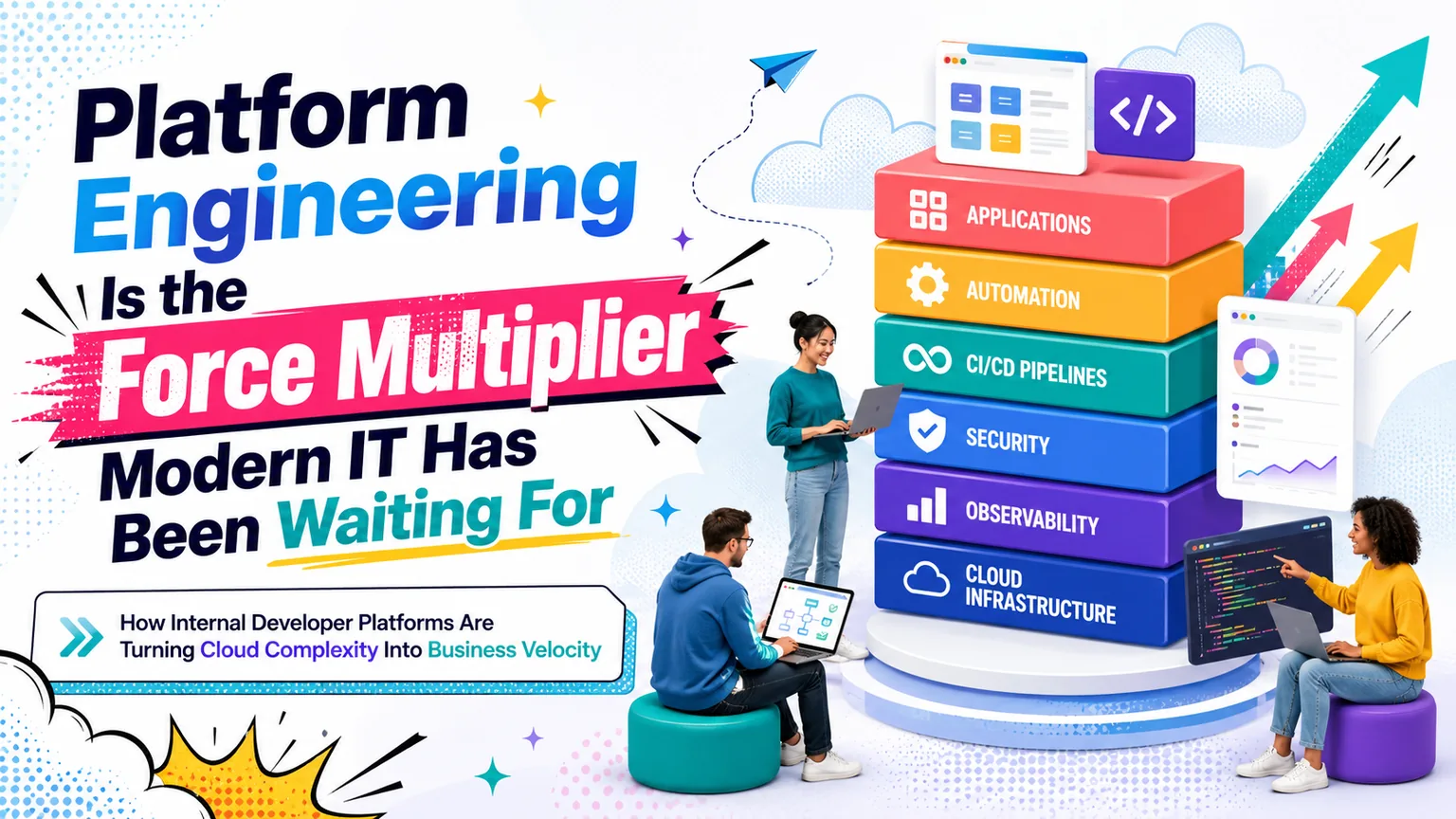
Platform engineering improves delivery speed and reliability by turning recurring infrastructure, security, observability, and governance work into supported self-service paths. It does not remove complexity; it moves that complexity to a product-minded platform team so application teams can focus on customer outcomes without rebuilding the same operational controls.
For years, technology leaders have been told to move faster, reduce costs, improve security, modernize infrastructure, support developers, adopt cloud-native technologies, prepare for artificial intelligence, and somehow make the entire environment easier to operate.
That is a reasonable list of priorities.
It is also a completely unreasonable list to hand to every individual development team.
Modern application delivery has become too complex for every engineer to master every part of the technology stack. Developers are now expected to understand cloud networking, Kubernetes, identity, secrets management, compliance, observability, infrastructure as code, CI/CD, vulnerability management, disaster recovery, and cloud financial governance before they can deliver a customer-facing feature.
That is not empowerment.
That is organizational friction disguised as autonomy.
Platform engineering is gaining momentum because enterprises are finally recognizing that complexity should be managed once, centrally, and delivered back to engineering teams as a simple, secure, self-service experience.
I have built platform engineering teams at AdvancedMD and Nymbus, and I have seen firsthand what happens when an organization moves from fragmented infrastructure to a reusable platform operating model.
The conversation changes.
Developers stop asking how to provision infrastructure and start asking how quickly they can launch. Security teams stop chasing every application independently and start embedding controls into the delivery pipeline. Operations teams stop processing repetitive requests and start engineering scalable capabilities. Executives gain greater predictability across cost, risk, reliability, and delivery.
Platform engineering is not another layer of IT.
It is the force multiplier that helps every other technology function perform at a higher level.
The Real Problem Is Not a Lack of Tools
Most enterprises do not have a tooling problem.
They have too many tools.
A typical application team may interact with multiple cloud platforms, source code repositories, build systems, deployment tools, container registries, Kubernetes environments, monitoring platforms, ticketing systems, security scanners, identity providers, secrets managers, and cost dashboards.
Every one of those technologies may be valuable.
The problem is that someone still has to connect them.
When those connections are not delivered as a coherent platform, every development team creates its own version of the same workflow. One team builds a deployment pipeline. Another creates a different pipeline. One application logs to the enterprise observability platform. Another stores logs locally. One team follows an approved security pattern. Another discovers the requirement during a production review.
The result is a growing collection of snowflake environments.
They are expensive to maintain, difficult to secure, hard to troubleshoot, and nearly impossible to scale consistently.
Platform engineering addresses that problem by transforming shared technology capabilities into a product.
Instead of giving developers a catalog of tools and asking them to assemble the solution, the platform team delivers a supported path from code to production.
That path can include infrastructure provisioning, policy enforcement, automated testing, deployment, monitoring, identity, data protection, and cost attribution.
The platform absorbs complexity so product teams do not have to.
An Internal Developer Platform Is the Product
The most visible outcome of platform engineering is often an internal developer platform, commonly called an IDP.
An internal developer platform provides developers with a standardized way to request, build, deploy, observe, and manage applications. It may include a developer portal, service catalog, templates, APIs, automation workflows, CI/CD pipelines, Kubernetes services, cloud environments, databases, and operational dashboards.
The important word is not internal.
The important word is product.
Successful platform teams treat developers as customers. They research where developers lose time, identify recurring pain, prioritize capabilities, measure adoption, maintain documentation, and improve the platform based on feedback.
That is a very different operating model from building infrastructure and declaring the work complete.
A platform can be technically impressive and still fail if no one wants to use it.
The platform must be easier than the alternative.
It should help a developer move from an approved idea to a functioning service without navigating a maze of forms, tickets, handoffs, and undocumented processes. It should provide sensible defaults without preventing legitimate innovation. It should make the secure path the fastest path.
The Cloud Native Computing Foundation has emphasized this product-oriented approach in its guidance on cloud-native platforms. The platform should be designed around user needs and business value streams, not around the organizational chart or the preferences of the infrastructure team.
That principle is foundational.
The platform exists to accelerate outcomes, not to showcase technology.
The Golden Path Should Feel Like a Fast Lane
One of the most powerful ideas in platform engineering is the golden path.
A golden path is a supported and automated route for completing a common engineering task. It might allow a developer to create a new application, deploy a service, request a database, establish a test environment, configure monitoring, or connect to an approved data source.
The goal is not to eliminate every choice.
The goal is to eliminate unnecessary decisions.
Imagine a developer creating a new application through a standardized template. The platform automatically creates the repository, deployment pipeline, infrastructure configuration, logging, monitoring, security controls, ownership metadata, backup policy, and cost allocation tags.
The developer begins with a production-ready foundation rather than an empty folder and a collection of wiki links.
That is leverage.
Google Cloud has described golden paths as a way to reduce cognitive load and improve consistency across engineering organizations. That benefit becomes increasingly important as enterprises adopt more cloud-native services and distributed architectures.
A golden path also creates a practical balance between speed and governance.
Executives often believe they must choose between developer agility and enterprise control. Platform engineering shows that the two can reinforce each other.
When security, compliance, observability, and cost management are built into the platform, teams move faster because they are not rebuilding those capabilities for every application.
The controls do not disappear.
They become automated.
Platform Engineering Is DevOps at Enterprise Scale
Platform engineering is sometimes described as a replacement for DevOps.
It is not.
DevOps remains one of the most important cultural and operational shifts in modern technology. It encourages collaboration, automation, rapid feedback, shared accountability, and continuous improvement.
Platform engineering takes those principles and makes them reusable.
DevOps taught organizations to remove the wall between development and operations. Platform engineering creates a highway across the gap.
The platform team builds shared services that product teams can consume without needing to recreate the underlying engineering. Site reliability engineering contributes operational discipline through service-level objectives, error budgets, incident response, and reliability practices. Security teams contribute policy, identity, vulnerability management, and governance.
These disciplines should not compete for ownership.
They should operate as an integrated system.
The enterprise does not win by choosing between DevOps, SRE, cloud engineering, security engineering, and platform engineering.
It wins by connecting them.
What I Learned Building Platform Teams at AdvancedMD and Nymbus

At AdvancedMD, the platform conversation was inseparable from healthcare delivery.
Healthcare technology must remain available, secure, responsive, and compliant. Platform decisions affect physicians, medical staff, business operations, partners, and ultimately patients.
The organization needed speed, but not reckless speed.
A platform engineering model helped create repeatable patterns for infrastructure, application delivery, cloud operations, security, and scalability. Instead of asking each team to independently interpret the enterprise requirements, we could embed those expectations into reusable services.
At Nymbus, the context was financial technology.
Financial services organizations operate in an environment where innovation, data security, reliability, and regulatory responsibility must coexist. The infrastructure spanned cloud-native platforms, Kubernetes, managed cloud services, application delivery systems, and security controls.
The need for platform engineering was not theoretical.
As complexity increased, the organization needed a way to preserve speed without multiplying operational risk.
In both companies, one lesson stood out: developers do not want less responsibility. They want less waste.
They want to own their applications, customer outcomes, performance, and quality. They do not want to spend days interpreting cloud permissions, troubleshooting inconsistent pipelines, or discovering undocumented infrastructure dependencies.
A strong platform respects developer ownership while removing repetitive work.
That is how technology leaders elevate their teams.
Not by lowering expectations, but by giving talented people a better system in which to perform.
Security Becomes a Built-In Capability
Traditional security reviews often occur too late.
An application is designed, built, and nearly ready for production before the security team discovers an issue. At that point, the organization is forced to choose between delay, redesign, or risk acceptance.
Platform engineering moves security earlier.
Approved identity patterns, secrets management, encryption, network controls, vulnerability scanning, software supply-chain protections, audit logging, and policy enforcement can be integrated directly into the platform.
Developers receive security by default.
Security teams gain greater consistency and visibility.
The enterprise reduces the number of unique configurations that must be reviewed and supported.
This is especially important for regulated environments, where demonstrating control is nearly as important as having the control. Automated workflows can produce evidence showing how environments were provisioned, which policies were applied, who approved changes, and what testing occurred.
That turns compliance from a periodic scramble into an operational capability.
Platform Engineering Can Rein In Cloud Costs
Cloud computing promised flexibility and speed.
It delivered both.
It also made it remarkably easy to create waste at scale.
Without clear ownership, automated shutdown policies, standardized sizing, usage visibility, and cost allocation, cloud spending can grow faster than business value.
Platform engineering creates an opportunity to embed FinOps practices into the application lifecycle.
The platform can apply required tags, associate resources with teams and products, recommend approved instance sizes, shut down temporary environments, surface cost data, and enforce budget guardrails.
This is far more effective than asking finance teams to investigate spending after the invoice arrives.
The goal is not to make developers afraid of using the cloud.
The goal is to help them understand the financial impact of architecture decisions while they still have the opportunity to change them.
Cost optimization should be part of the platform experience, not an annual emergency.
AI Makes the Platform More Important, Not Less
Artificial intelligence is accelerating software creation.
Developers can generate code, tests, documentation, scripts, and prototypes faster than ever before. Business teams can experiment with AI applications without waiting for traditional development cycles.
That speed is exciting.
It also creates a new wave of operational demand.
More applications mean more deployments, infrastructure, data access, secrets, security controls, monitoring, and cloud consumption. AI systems introduce additional requirements around model access, data governance, evaluation, inference cost, privacy, and auditability.
Without a platform, AI can accelerate fragmentation.
With a platform, AI can accelerate business value.
A modern internal developer platform can provide approved AI services, secure model endpoints, standardized retrieval-augmented generation patterns, governed data access, evaluation frameworks, observability, and cost controls.
The platform becomes the launchpad for responsible enterprise AI.
This is why AI strategy cannot be separated from platform strategy.
The organizations that move fastest will not simply be the ones with access to the best models. They will be the ones with an operating environment that allows teams to use those models safely, repeatedly, and economically.
Measure Outcomes, Not Platform Activity
Technology teams love measuring what they build.
Executives need to measure what improves.
The success of a platform engineering program should not be based on the number of tools installed, templates created, or Kubernetes clusters deployed.
The meaningful metrics are closer to the business.
How long does it take to create a development environment?
How quickly can a new service reach production?
How many manual approvals have been eliminated?
How often do deployments fail?
How long does recovery take?
How much engineering time is spent on repetitive infrastructure work?
How quickly can a new employee become productive?
How much cloud waste has been reduced?
How many teams voluntarily adopt the platform?
The 2024 DORA research reinforced that platform engineering can deliver substantial value, but the journey must be user-centered and product-driven. Organizations may also experience a temporary performance decline while teams adapt to a new platform and operating model.
That is an important leadership lesson.
Transformation is not always a straight line.
Leaders should expect a period of adjustment, support the teams through it, and remain focused on the long-term outcomes.
Start Small, Prove Value, Then Scale
The biggest mistake in platform engineering is trying to build everything at once.
Do not begin with a massive multiyear platform transformation.
Begin with one painful workflow.
Find the process that generates the most tickets, delays, manual effort, or frustration. It may be environment provisioning, application onboarding, database requests, deployment pipelines, or observability setup.
Build a golden path for that use case.
Put it in front of real users.
Measure the difference.
Then expand.
Create a cross-functional team that includes platform engineering, development, operations, security, architecture, and product management. Give the team executive sponsorship, but keep it close to developers.
A platform built in isolation will solve imaginary problems beautifully.
A platform built alongside its users can transform the organization.
The Future Belongs to Companies That Productize Their Expertise
Every enterprise has technical knowledge distributed across its best people.
A cloud architect knows how environments should be designed. A security engineer knows which controls matter. An operations leader understands reliability. A database engineer knows how to create resilient data services. A financial operations specialist understands cloud economics.
Without a platform, that expertise is delivered through meetings, tickets, documents, and tribal knowledge.
With a platform, it becomes reusable.
That is the strategic value of platform engineering.
It converts organizational knowledge into a product that every engineering team can consume.
Developers gain speed.
Security gains consistency.
Operations gains scalability.
Finance gains visibility.
Executives gain predictability.
Customers gain better digital experiences.
Platform engineering is not exciting because it introduces another technology trend. It is exciting because it allows the enterprise to operate at a higher level.
After more than two decades in technology leadership, I see it as one of the clearest opportunities we have to elevate both people and performance.
The future will not belong to the company with the largest cloud footprint, the most Kubernetes clusters, or the longest list of tools.
It will belong to the organization that creates the simplest path from a great idea to a secure, reliable, and valuable customer outcome.
That is what platform engineering makes possible.
And we are only getting started.
Further Reading
-
Gartner: Top Strategic Technology Trends in Software Engineering for 2024
-
Google Cloud: Golden Paths for Engineering Execution Consistency
Platform Engineering: Frequently Asked Questions
What is platform engineering?
Platform engineering builds reusable, self-service capabilities that absorb infrastructure complexity and give product teams a supported path from code to production.
What is an internal developer platform?
An internal developer platform is the product created by a platform team: a standardized way to request, build, deploy, observe, secure, and manage applications.
How does platform engineering relate to DevOps?
Platform engineering does not replace DevOps. It productizes DevOps, SRE, cloud, and security practices so teams can consume them consistently at enterprise scale.
What outcomes should a platform engineering team measure?
Measure lead time, deployment reliability, recovery time, developer onboarding, manual work removed, cloud waste reduced, and voluntary platform adoption.
How should an enterprise start with platform engineering?
Start with one painful, high-volume workflow, build a golden path with real users, measure the result, and expand only after the platform proves its value.