
Cybersecurity becomes an enterprise issue as soon as a decision trades capital, continuity, legal exposure, reputation, or customer trust. Patch levels and firewall events still matter, but they do not tell an executive team which business services are exposed, what interruption the company can tolerate, or which risk deserves the next dollar.
NIST’s Cybersecurity Framework 2.0 made that connection explicit by adding a Govern function and describing cybersecurity alongside other sources of enterprise risk. The SEC’s disclosure rule likewise requires covered public companies to describe cybersecurity risk processes, management’s role, board oversight, and material incidents. Neither development makes security solely a board activity. Both make it harder to pretend it belongs only to IT.
The operating context includes managing cloud uncertainty as risk, building resilient AI infrastructure, and treating a major platform change as an enterprise migration decision.
The implication is clear. When you view cyber risk through this lens, your organization stops reacting to breaches and starts designing for resilience. You move from a model of fear-based compliance to one of curiosity-driven capability. Technology should produce business outcomes, reduce meaningful risk, improve capability, or improve customer outcomes. It must do so without creating new dependencies that threaten the whole company.
The Governance Gap in Modern Organizations
Security may have a capable technical organization and still be poorly integrated into enterprise decisions. A business unit can accept a supplier dependency, a product team can change customer data use, or finance can constrain recovery investment. Each choice may look rational locally while moving risk somewhere else. The operating model has to expose those transfers and assign a business owner to the decision.
This separation leads to blind spots. An IT team might deploy a security control that blocks a critical business process, causing revenue loss that dwarfs any potential threat mitigation. Conversely, a business unit might take on new cloud infrastructure that expands attack surface without understanding the resulting legal or reputational exposure. The result is a fragmented defense where risk is managed in pieces rather than as a unified enterprise asset.
Ownership should follow the business consequence. Security protects data, but it also supports the ability to operate, customer trust, contractual commitments, safety, and future investment. Framing the risk in those terms gives division leaders and enterprise functions a common decision, rather than asking everyone to translate a technical severity score on their own.
Mapping Risk Ownership Across the Enterprise
To bridge the gap between technical execution and executive decision-making, organizations need a clear map of who owns what risk. This is not about assigning tasks; it is about clarifying accountability for outcomes. The goal is to ensure that every division leader understands their role in serving the enterprise’s broader vision while managing their specific exposure.
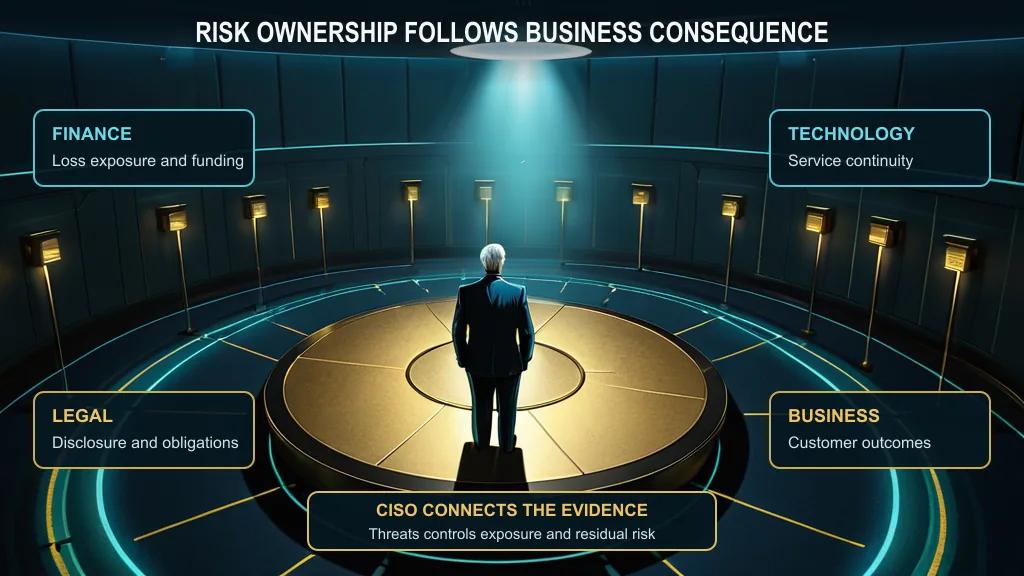
Consider a simple framework for this mapping. At the top sits the Enterprise Risk Committee, responsible for setting materiality thresholds and overseeing resilience tradeoffs. Below them sit the functional leaders: CFOs, CTOs, Chief Legal Officers, and Head of Customer Experience. Each has a specific domain where cyber risk is material.
Titles differ by company, so the map should follow decisions rather than an org chart. Finance helps evaluate loss exposure and funding tradeoffs. Technology and operations own service continuity. Legal and compliance interpret disclosure, privacy, and contractual obligations. Business leaders define which customer and operational outcomes cannot be interrupted. The CISO connects the threat and control evidence across all four.
The map determines who has to participate and who accepts residual risk. A cloud-provider change, for example, can affect capital allocation, continuity, contracts, data location, and operations. Making those dependencies explicit does not prevent failure. It prevents the enterprise from discovering during an incident that nobody owned the tradeoff.
Materiality and Resilience Tradeoffs
One of the most difficult conversations in enterprise leadership is balancing materiality and resilience. Leaders often face pressure to cut costs or speed up time-to-market, which can conflict with robust security practices. The challenge is not to say “no” to business needs but to ask “how do we achieve this safely?”
Materiality determines what risks actually matter. Not every vulnerability is a threat. However, ignoring a vulnerability in a system that holds customer payment data or proprietary intellectual property is a strategic error. Resilience is the ability to absorb a shock and recover quickly. A resilient organization does not prevent all attacks; it ensures that when an attack occurs, the business continues to function and customers remain trusting.
This requires a shift from prevention-focused thinking to outcome-focused thinking. Prevention is a tactic; resilience is a strategy. If your goal is to stop every breach, you will eventually fail because new threats emerge faster than you can patch them. If your goal is to maintain continuity and trust, you build redundancy, clear incident response plans, and transparent communication channels.
For example, a ransomware decision may involve restoration order, customer communication, regulatory analysis, operational workarounds, and cash exposure at the same time. No security tool can make all of those choices. The enterprise has to decide its tolerances in advance and test whether the recovery plan can meet them.
Decision-Ready Metrics for Executives
Executives need metrics that tell them something meaningful about the state of the enterprise. IT teams often report on ticket counts, patch percentages, or threat detection rates. These are useful for engineers but confusing for leaders who care about money, time, and reputation. You need a set of decision-ready metrics that translate technical events into business outcomes.
Here is a practical framework for translating cyber risk into executive language:
Capital Impact
- Cost of Remediation: Average cost to fix a critical vulnerability found in a production system.
- Downtime Cost: Financial loss per hour of service interruption due to security incidents.
- Capital Allocation Efficiency: Ratio of security spend to total revenue growth, adjusted for risk reduction.
Continuity and Resilience
- Recovery Time Objective (RTO) Met Rate: Percentage of critical systems restored within agreed timeframes after an incident.
- Incident Frequency vs. Severity: Trend in the number of incidents weighted by their potential business impact.
- Backup Integrity Score: Verified success rate of restoring data from off-site backups.
Reputation and Trust
- Customer Notification Latency: Time taken to inform affected customers of a breach (SEC disclosure requirement).
- Brand Sentiment Shift: Change in public perception metrics following a known security event.
- Regulatory Fines Avoided: Estimated potential fines prevented through proactive governance.
These metrics allow leaders to make informed decisions. They can see if their security investments are paying off in terms of reduced downtime or avoided fines. They can also compare the cost of doing business without strong controls against the cost of implementing those controls. This transparency fosters trust between the board and the technology teams.
The Cadence of Enterprise Cyber Governance
Cyber risk does not resolve itself with a single policy document. It requires an ongoing cadence of governance that keeps the enterprise alert and responsive. This is not about weekly status meetings; it is about regular reviews of material risk exposures and resilience capabilities.
The most effective governance model involves a quarterly cycle aligned with the board’s strategic planning. During these sessions, the Enterprise Risk Committee should review the state of cyber risk across all divisions. They should ask: Are we managing the right risks? Is our response to incidents improving? Do our controls support our business strategy?
This cadence ensures that cybersecurity remains a dynamic part of enterprise management rather than a static compliance checkbox. It allows leaders to adjust strategies as new threats emerge and business conditions change. For instance, if a major regulation changes or a new type of attack vector becomes common, the governance process triggers an immediate review of controls and training.
Furthermore, this regular engagement builds a culture of ownership. When division leaders know they will be held accountable for their risk posture on a schedule, they take their responsibilities seriously. It moves cyber risk from being something that happens to IT to something that everyone manages as part of their daily operations. This is the foundation of true enterprise resilience.
Make the Next Review a Decision Meeting
The quickest test of this model is the next cyber review. Put one critical business service on the agenda. Name its owner, current exposure, tested recovery time, unresolved exception, and required decision. If the meeting ends with another request for a larger dashboard, the governance model has not changed. If it ends with an owner, a tolerance, and a funded action, cybersecurity has started to operate as enterprise risk.