The Compromise Myth
Hybrid cloud is a control decision, not a compromise between public cloud and private infrastructure. It gives an enterprise deliberate choices about workload placement, data boundaries, resilience, economics, operational authority, and exit options—provided leaders define those controls before architecture turns into an accidental collection of platforms.
Hybrid cloud is often described as a comfortable middle ground between public-cloud agility and private control. That description hides the work. Multiple environments create integration, skills, identity, observability, support, and recovery obligations. The problem is not hybridity itself. It is an accidental inventory of exceptions with no documented placement reason or exit trigger.
The placement decision should draw on cloud risk guardrails, lessons from reassessing a data center platform, and the infrastructure requirements of enterprise AI.
Pursue a hybrid strategy when workload placement is governed by explicit control requirements and economic constraints. If the primary driver is avoiding a hard choice between public and private, the likely result is complexity rather than resilience. The goal is not to keep everything in two places. It is to put each workload where the enterprise can best control its risk, service level, and cost.
Control Drives Placement Decisions
Workload placement should not be based on convenience or vendor lock-in avoidance alone. It should begin with explicit requirements for data, recovery, performance, cost, jurisdiction, and operational ownership. Control is valuable only when leaders can name which decision they need to retain and what they are willing to pay to retain it.
The EU Data Act, applicable from September 12, 2025, addresses cloud switching, interoperability, and obstacles to moving between data-processing services. For an infrastructure leader, the practical lesson is to treat portability as something that must exist in contracts, architecture, data formats, and operating procedures. A diagram showing two available clouds is not evidence that a workload can move between them.
CSF 2.0 connects organizational context, dependencies, legal requirements, resilience, and enterprise risk decisions. If a workload has no explicit placement requirement, such as latency, recovery, data-location, supplier concentration, or custody, a hybrid design may add complexity without buying useful control. That does not make hybrid wrong. It makes the rationale testable.
Standardization matters more than location. The most successful organizations are those that standardize their interfaces, APIs, and operational procedures regardless of where the workload resides. They treat the cloud as a resource pool rather than a destination. When you prioritize control requirements over platform agnosticism, you create an architecture that is resilient by design. You ensure that if one environment fails or becomes economically unviable, your ability to migrate or replicate workloads remains intact because the underlying logic is uniform.
The Economics of Exit Costs
Economics in cloud infrastructure are often misunderstood as a simple matter of per-virtual-machine pricing. In reality, the true cost of hybrid architecture lies in the exit costs, the time, money, and effort required to move data and applications between environments when business needs change.
The optionality versus complexity tradeoff is the central tension in infrastructure strategy. A new environment can add a theoretical option while also adding enough operational complexity to make that option difficult to use. The exit-cost test is simple: if this environment became unsuitable, what would it take to move the workload and its data to the next acceptable location?
If the answer involves significant downtime, data migration challenges, or the need to rebuild applications from scratch, then your hybrid strategy is failing you. You have created an accidental inventory of exceptions where each environment operates as a silo with its own unique quirks, tools, and dependencies. This leads to FinOps nightmares where cost savings in one area are quickly eroded by the complexity of managing multiple distinct ecosystems.
Some workloads will belong entirely in one environment because duplicating them buys little. Others may justify portable data, a tested recovery target, or a credible switching path. The goal is not to keep everything in two places, and no placement decision lasts forever. The goal is to document the control being purchased, its operational cost, and the trigger that would justify moving again.
Resilience Through Explicit Rules
Resilience in a hybrid environment does not come from having backups in multiple locations; it comes from having explicit rules that govern how those backups are managed, accessed, and restored. Without these rules, resilience devolves into ad-hoc firefighting where teams discover they have no way to access critical data when it is needed most.
The Data Act’s focus on interoperability highlights that switching depends on usable formats, interfaces, responsibilities, and timeframes. Provider-specific capabilities may be the right business choice, but their exit cost should be visible. Resilience does not require effortless portability. It requires a tested alternative and an honest estimate of the work needed to use it.
This brings us back to the leadership lens that technology should reduce meaningful risk. A hybrid setup that increases the cognitive load on your operations team is not reducing risk; it is amplifying it. Risk management is about making decisions based on known constraints and clear trade-offs, not guessing which environment will behave better under stress. Explicit rules provide the clarity needed to make these decisions. They define what data belongs where, how long it stays there, and what happens if that location becomes unavailable.
Put the decision rules in architecture and risk policy so teams know which evidence is required and who can approve an exception. Then test whether the selected environment can meet the recovery and continuity promise. That connects CSF 2.0’s enterprise-risk emphasis to a workload-placement decision that operations can actually execute.
Count the Human Operating Cost
Every additional platform adds runbooks, access models, upgrades, incident paths, skills, contracts, and on-call expectations. That work belongs in the placement decision. A design that saves infrastructure dollars while forcing a small team to support three incompatible control planes may be the expensive option.
Bring the people who will operate and recover the workload into the decision before the architecture becomes permanent. Their job is not to defend a preferred platform. It is to identify the recurring work, failure modes, and skills the enterprise is agreeing to fund.
Standardization Over Location
In the end, the most robust cloud strategy is one where standardization matters more than location. Whether you run workloads on-premises, in a public cloud, or in a private data center, the principles of governance, security, and economics should remain consistent. This does not mean treating all environments identically; it means ensuring that the logic applied to each is uniform and predictable.
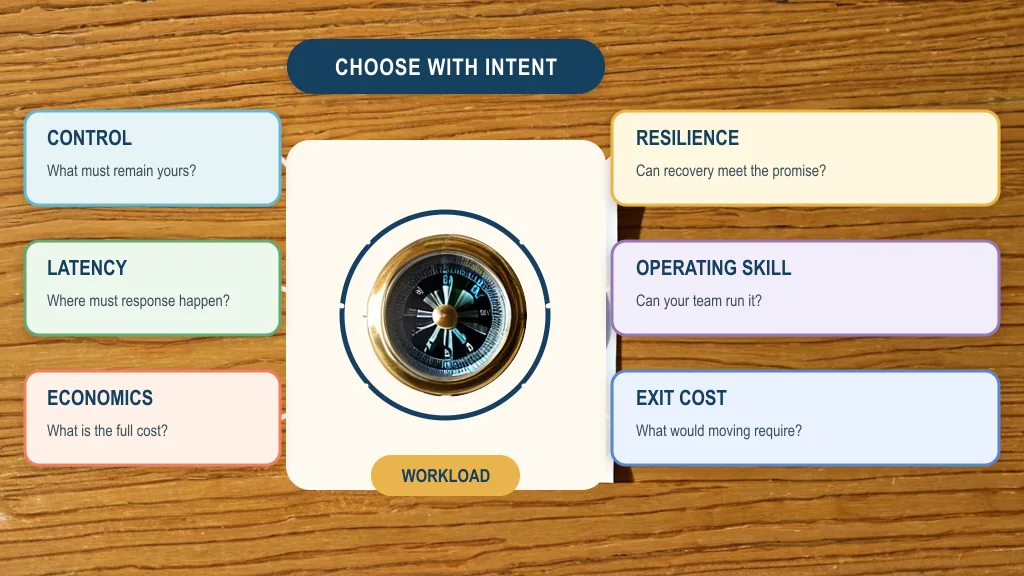
Use a placement matrix that covers control, latency, economics, resilience, operational skill, and exit cost. Then record why the workload belongs where it does and what would trigger reconsideration. Hybrid cloud earns its complexity when those decisions remain explainable and testable. Otherwise, it is simply an inventory of exceptions with a better name.