Cohere and Aleph Alpha have signed a definitive business-combination agreement. For CIOs, the important signal is not simply that two AI companies plan to become one. It is what the combined company intends to sell: capable enterprise AI with more choice over deployment, data handling, infrastructure, and jurisdiction.
That moves the enterprise conversation in a healthy direction. The model still matters, of course. But production buyers have a longer scorecard than a model leaderboard. They need to know where a workload can run, who controls its data and identity, how policy is enforced, what inference costs at scale, whether operations can be audited, and how difficult it will be to change course.
Enterprise AI competition is shifting from model versus model toward operating model versus operating model.
The practical response is not to pick a sovereign-AI winner today. Build an enterprise control layer, score providers on capability and operability, and preserve enough portability to benefit when models, prices, regulations, and vendors change.
The agreement is really a buyer signal
On September 16, Cohere and Aleph Alpha announced that they had signed the binding agreement first contemplated in April. The transaction still requires regulatory approval and is expected to close later in 2026.
The unified business would operate globally as Cohere, with headquarters in Toronto and Berlin and Aleph Alpha’s Heidelberg office continuing as a research center. Cohere says the combined workforce would exceed 1,000 people. It also plans to deepen its partnership with Schwarz Group and deliver sovereign AI on the German company’s STACKIT cloud service.
Reuters reported that the planned combination was valued at roughly $20 billion when it was first disclosed in April. Schwarz Group is investing €500 million and is expected to provide computing capacity through STACKIT. Those details connect three things enterprise buyers too often evaluate separately: models, software, and the infrastructure beneath them.
This is not proof that the transaction will succeed, that one deployment model will dominate, or that “sovereign” is a magic word. It is evidence that control has become valuable enough to organize capital, product strategy, and infrastructure around it.
The smartest model does not automatically win the enterprise
Technology markets adore a beauty contest. Bigger benchmark score, longer context window, shinier demo—lovely. Then Monday morning arrives carrying an audit request, a latency problem, and a finance partner wondering why inference cost tripled.
Enterprises do not operate benchmarks. They operate services.
A remarkable model can still be wrong for a workload if sensitive context must leave an approved boundary, capacity is uncertain, latency misses the business need, costs are unpredictable, or the platform cannot produce the evidence risk teams require.
CIOs should separate two questions:
- Which model performs this task well enough?
- Which operating environment gives the business the right control?
The answers may point to the same vendor. They may not. Keeping the questions separate prevents model enthusiasm from quietly becoming an enterprise architecture.
Use a six-part enterprise AI scorecard
I would evaluate an enterprise AI provider across six dimensions. None should be allowed to hide behind another.
1. Capability
Can the model perform the actual workload reliably against a representative evaluation set? Test the task, language, tools, data, and failure modes that matter to the business—not only a public benchmark.
2. Economics
What is the fully loaded production cost at expected volume? Include inference, reserved capacity, data movement, retrieval, observability, evaluations, support, and the people needed to operate the service.
3. Control
Can the enterprise enforce its own identity, authorization, data, retention, tool, and approval policies? Can it see which model version ran, which data was retrieved, which tool was invoked, and who initiated the request?
4. Placement
Can the workload run where policy and performance require it—public API, managed cloud, dedicated environment, private cloud, company-operated infrastructure, or a particular geography?
Private AI is a placement option, not an ideology. Some workloads belong in a public model service because the capability and economics are excellent. Others justify an isolated environment or customer-controlled infrastructure. The useful capability is choice.
5. Portability
How much application code, data, operational procedure, and evaluation work must change to use another model or environment? “We support multiple models” is not enough. Ask for the measured cost and time of a tested change.
6. Operability
Can teams observe, support, secure, recover, govern, and eventually retire the service? A spectacular demonstration that becomes a mysterious production dependency is not a bargain.
This scorecard is intentionally less glamorous than a leaderboard. That is its charm. It turns a vendor conversation into an operating decision.
Sovereignty is a dependency map, not a flag
Sovereign AI is sometimes reduced to the country on a vendor’s letterhead. Geography and jurisdiction matter, but a map pin cannot tell you who holds encryption keys, where support personnel operate, which sub-processors receive data, what the software supply chain depends on, or whether the workload can continue after a provider relationship changes.
For an enterprise, sovereignty should mean: we understand the dependencies required to operate this workload, we chose them deliberately, and we know which controls remain ours.
That includes data location, processing location, identity, encryption, legal jurisdiction, infrastructure ownership, logging, staffing, supply-chain dependencies, recovery, and exit. It does not mean every workload must retire to a company-owned server room and live there forever.
The broader enterprise architecture test for AI sovereignty is whether the organization can maintain control when a provider, price, model, regulation, or risk decision changes. The Cohere–Aleph Alpha agreement gives that test a fresh and unusually concrete market example.
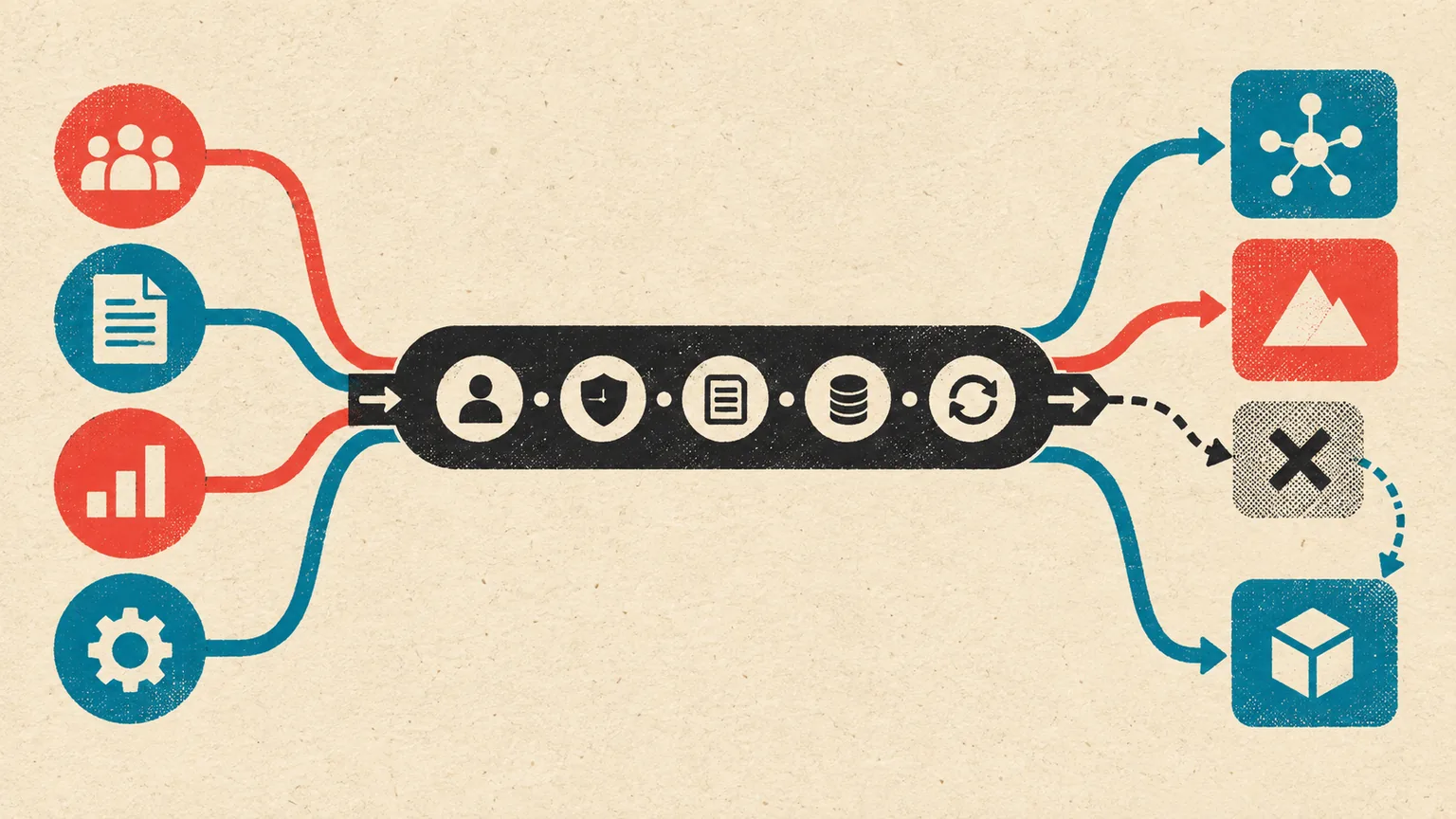
Put a control layer between applications and models
The quickest integration is often a direct call from an application to one model API. It is also how provider-specific authentication, prompts, tool schemas, error handling, and logging spread through the codebase like cheerful little vines. They look harmless until someone asks you to move the wall.
A better pattern places a controlled interface between applications and model providers. Depending on scale, that layer can provide:
- centralized identity and credential handling;
- policy enforcement and data classification;
- model and tool routing;
- usage records, cost allocation, and rate limits;
- consistent telemetry and audit evidence;
- safety and quality evaluations; and
- fallback models and recovery paths.
The application requests a capability; the platform decides how to fulfill it within policy. This is the architectural center of a multi-model enterprise.
Do not turn the gateway into a lowest-common-denominator prison. Provider-specific capabilities can create real value. Use them when the advantage is worth the coupling, but record that dependency and price its exit cost. Optionality does not require pretending every model is identical. It requires knowing where they are not.
The shared layer also becomes a consequential asset. If it governs identity, tools, routing, policy, or recovery across many workloads, protect the AI control plane as a Tier Zero asset with privileged administration, change control, resilient logging, and its own tested recovery path.
Governance is becoming a product capability
For a regulated buyer, governance cannot live entirely in a slide deck. It has to appear in the product and operating evidence.
A bank, healthcare organization, manufacturer, government agency, or critical-infrastructure operator may need to show which model and version executed, where processing occurred, what data was accessed, which tools were available, which actions required approval, how outputs were evaluated, and how an incident can be investigated.
That makes auditability, policy enforcement, deployment isolation, and lifecycle management part of the buying decision. The platform that helps a CIO answer those questions may beat a nominally stronger model that creates a small administrative carnival for security, legal, compliance, and operations.
This is also why a minimum viable AI governance model should be connected to the platform. Inventory, ownership, evidence requirements, and review triggers work better when the system produces the evidence by design.
Infrastructure has returned to the conversation
AI briefly looked like it might make infrastructure disappear. Call an API; receive intelligence. Very tidy.
At enterprise scale, the physical world politely re-enters the room. Latency matters. Data movement matters. Accelerator capacity, power, resilience, and inference economics matter. Jurisdiction matters. A model service still rests on clouds, data centers, networks, energy, and people.
The STACKIT relationship is therefore not a footnote. It shows how enterprise AI competition can join model research, integration software, customer access, financing, and sovereign cloud capacity into one offering.
That vertical alignment may improve delivery. It can also create a broader dependency. Procurement should ask whether the combined stack increases practical control for the customer or merely moves lock-in from one layer to several. A sovereign bundle still needs an exit door.
Give the CIO ninety days, not a crystal ball
No CIO needs to predict which model vendor will lead in three years. A useful response to this deal is much more grounded.
Days 1–30: Find the concentrated dependencies
Choose the most material AI workloads and map model, gateway, data, retrieval, identity, tool, logging, infrastructure, and contract dependencies. Identify direct provider calls scattered through applications. Record who owns each service and what happens if its current model becomes unavailable.
Days 31–60: Apply the scorecard
Score the current provider and one credible alternative across capability, economics, control, placement, portability, and operability. Use evidence from the real workload. Require architecture, security, finance, legal, operations, and the business owner to agree on the accepted tradeoffs.
Days 61–90: Test one route out
Move one meaningful workflow to a second model or deployment environment. Re-run the same quality, safety, latency, and cost evaluations. Measure code changes, staff time, data movement, service interruption, and lost provider-specific capability.
That exercise turns “multi-model” from a conference adjective into an estimated switching cost. It also reveals whether the day-two enterprise AI operating model has real owners, telemetry, incident procedures, and recovery discipline.
Consolidation makes independence more valuable
The Cohere–Aleph Alpha transaction will not settle the enterprise AI market. It still awaits approval, integration details remain to come, and customers will have to judge the combined products on delivery rather than announcement language.
The larger pattern is still useful. Markets with large research, compute, sales, and integration costs tend to consolidate. Vendors will merge, specialize, change prices, retire models, shift infrastructure partners, and redraw product boundaries.
If one of those changes can threaten a business-critical AI workload, the dependency is already too deep—or at least too poorly understood.
The goal is not constant switching. Nobody wants a quarterly model migration festival. The goal is credible optionality: enough control to negotiate well, place workloads deliberately, recover from disruption, and adopt a better model without rebuilding the business process around it.
The model is important. The durable enterprise asset is the ability to choose, govern, and operate it.
Further Reading
- Cohere: Cohere and Aleph Alpha sign a definitive business-combination agreement
- Schwarz Digits: Cohere and Aleph Alpha sign an agreement for a transatlantic sovereign AI solution
- Reuters: Cohere and Aleph Alpha combine to target the enterprise AI market
- NIST: Artificial Intelligence Risk Management Framework
Enterprise AI Control: Frequently Asked Questions
What does the Cohere and Aleph Alpha agreement mean for enterprise CIOs?
It signals that enterprise AI vendors are competing on deployment choice, sovereignty, governance, infrastructure, and integration as well as model capability. CIOs should evaluate the operating environment around the model, not only benchmark results.
What is sovereign AI for an enterprise?
Sovereign AI means understanding and deliberately controlling the important legal, data, identity, infrastructure, operational, and continuity dependencies of an AI workload. It does not automatically require running every model in a company-owned data center.
Why does model portability matter?
Model portability gives an enterprise a credible way to respond when quality, price, capacity, regulation, geography, or vendor ownership changes. It also improves negotiating leverage, provided the alternative route is tested rather than merely documented.
Should an enterprise use more than one AI model?
Often, yes. Different workloads favor different combinations of capability, cost, latency, privacy, geography, and deployment control. A shared control layer can route work without forcing every application to integrate with every provider.