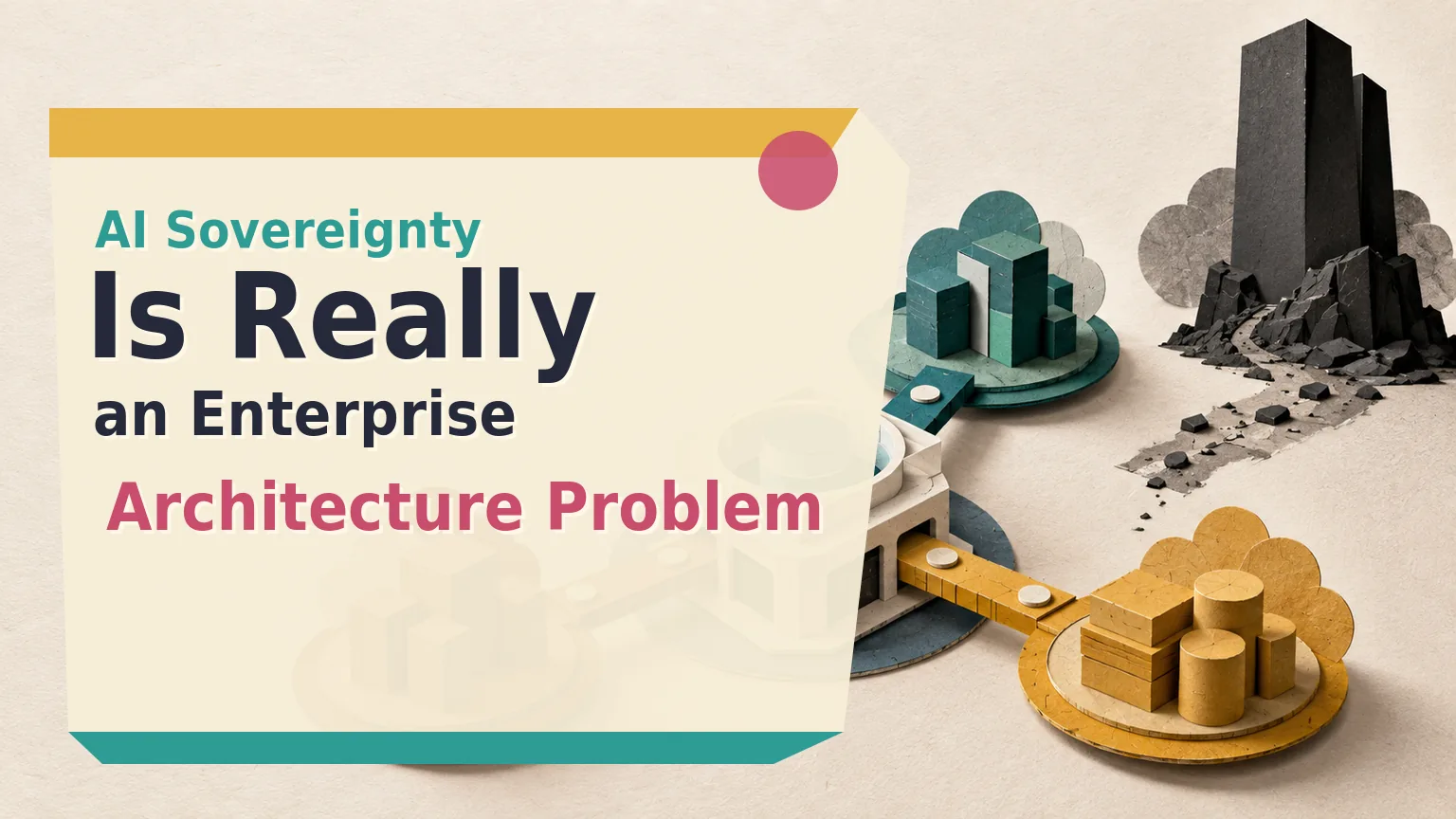
Mistral AI’s new €3 billion funding round is a useful signal for CIOs, but not because every enterprise should buy a European model. The lesson is that AI sovereignty has become an architecture and vendor-risk discipline. Build so the organization controls its data, can place inference where policy requires, and can change models without rebuilding the business process.
That is more practical than debating whether sovereignty belongs to one country, one cloud, or one model family. Geography matters. Law, ownership, and supply chains matter. But a flag on a vendor’s headquarters is not an exit strategy.
On September 8, Mistral announced a €3 billion Series D round at a post-money valuation above €21 billion. Samsung Electronics led the round, with the Scaleup Europe Fund and PSG Equity as co-leads. Mistral says the capital will expand research, compute capacity, infrastructure, commercial growth, and its international footprint.
That is the funding news. The enterprise question underneath it is simpler:
Can we keep control of a material AI workload when the model market, provider, price, regulation, or risk changes?
Sovereignty is control you can exercise
I do not use sovereignty as a synonym for buying local. For an enterprise, it should mean having meaningful control over:
- where sensitive data is stored and processed
- which models can receive prompts and retrieved context
- where inference runs and who operates that infrastructure
- which party controls identity, encryption keys, logs, and retention
- how a workload moves to a different model or environment
- what happens when a provider is unavailable or no longer acceptable
Those are architecture decisions with operational consequences. They affect security, compliance, cost, resilience, and negotiating leverage.
The model is only one dependency. A production AI service may also include an application, agent framework, model gateway, retrieval pipeline, vector store, document repository, identity provider, policy engine, tool connections, evaluation suite, telemetry, and cost controls.
If every one of those layers assumes the same provider, migration may remain technically possible while becoming economically unrealistic. I have seen that pattern in infrastructure more than once. The exit clause exists in the contract, but the real exit cost lives in application code, data movement, operational knowledge, and untested replacement paths.
Decide what must stay portable
“Avoid lock-in” is not an architecture. It is an aspiration until a team identifies the boundary that must remain portable.
Start with a material workflow, not the entire AI portfolio. Map the components that would have to change if the current model or inference provider disappeared next quarter. Then separate business logic and enterprise data from provider-specific behavior wherever the benefit justifies the work.
A useful design often has four properties:
- The application calls a controlled model interface. A gateway or orchestration layer handles credentials, policy, routing, usage records, and provider-specific adapters.
- Enterprise context remains an enterprise asset. Documents, retrieval logic, embeddings, indexes, agent state, and evaluation data have owners, retention rules, and export paths independent of one model endpoint.
- Model choice is explicit. The platform selects a model based on capability, sensitivity, location, latency, availability, and cost instead of hiding the decision in scattered application code.
- Replacement paths are tested. The team knows which alternative can carry the workload, what quality changes, and how long a cutover actually takes.
This is not an argument for a lowest-common-denominator abstraction. Models do not behave the same way. They differ in context handling, tool use, structured output, safety behavior, latency, and reasoning quality. Provider-specific features can create real business value.
The goal is to make those dependencies deliberate and visible. Use a specialized feature when it earns its migration cost. Do not let a convenience library quietly decide the enterprise’s long-term operating model.
The data layer matters more than the model name
The strategic value in an AI system often accumulates outside the foundation model. Prompts, business documents, retrieved passages, tool outputs, conversation state, agent memory, user feedback, and evaluation results can reveal how the organization works.
That makes data sovereignty more important than a model’s nationality.
For each production workload, I would want clear answers about where prompts and retrieved context are processed, what the provider retains, whether inputs are used for training, where logs travel, who can decrypt them, and whether the knowledge layer can serve another model.
A portable retrieval architecture does not require pretending that every embedding model or vector database is interchangeable. It does require preserving source documents, metadata, access rules, chunking logic, evaluation sets, and a reproducible way to rebuild an index. The vector store should not be the only surviving copy of enterprise knowledge.
This is one reason the day-two operating model for enterprise AI matters so much. Ownership, observability, lifecycle management, and recovery determine whether an AI pilot becomes durable infrastructure.

The architecture above keeps applications and enterprise context stable while model and hosting components can move. That separation creates options. It does not guarantee that a move will be easy.
Open-weight models create an option, not an exemption
Open-weight models can add a valuable deployment path. Depending on the model’s license, hardware needs, and supporting software, an enterprise may be able to run inference in a private cloud, a sovereign cloud, a dedicated environment, its own data center, or an edge location.
That flexibility can matter for regulated data, disconnected operations, latency-sensitive systems, predictable high-volume workloads, or regions where a managed service is not acceptable. Mistral’s own product documentation describes private-cloud and on-premises deployment options for enterprise workflows.
Open weights do not make the surrounding system open, portable, secure, or inexpensive. Teams still have to operate inference, patch dependencies, evaluate model changes, protect the serving stack, manage capacity, and verify the license for the intended use. A model that fits on owned hardware can still depend on a proprietary gateway, retrieval service, or agent platform.
Treat private inference as an option with a cost model and an operating owner, not a magic escape hatch.
Model routing is part of FinOps
AI economics move quickly. Token prices change. Smaller specialized models improve. New accelerators alter the cost of local inference. A model that is expensive but necessary for one task may be wasteful for another.
A workload hard-coded to one premium endpoint cannot take advantage of those changes without application work. A controlled routing layer can match the workload to the least expensive model that meets the required quality, latency, privacy, and availability targets.
The governing question should be visible in the cost review:
Why is this workload running on this model, in this environment, at this price?
That connects sovereignty to FinOps and workload optimization. Optionality is not only a geopolitical or compliance concern. It is how the enterprise preserves the ability to use a better cost curve.
Vendor flexibility is a continuity control
AI providers can suffer outages, retire models, change prices, alter contractual terms, restrict a geography, discontinue a product, or be acquired. A new regulation or internal risk decision can make a previously acceptable service unusable for one workload.
NIST’s AI Risk Management Framework is direct about the need to manage third-party AI risk. Its core calls for contingency processes for failures or incidents involving high-risk third-party AI systems, while the NIST AI RMF playbook recommends verifying continuity processes and considering redundant or backup systems.
For a material workflow, I would expect the service owner to know:
- the current model and provider dependencies
- the enterprise data and state tied to each dependency
- the replacement model already evaluated against the same test set
- the credentials, endpoints, policies, and integrations a cutover would change
- the quality, latency, capacity, and cost tradeoffs after migration
- the recovery time the business has actually accepted
A backup model that has never been tested is not a continuity plan. Neither is a multi-model gateway with only one production-ready provider behind it.
This is where AI sovereignty connects to the AI control plane as a tier-zero asset. Central routing and policy can reduce scattered dependencies, but the control plane itself now needs resilience, strict access, and a credible recovery path.
Run an exit test before calling the platform sovereign
Do not start with a theoretical enterprise-wide migration. Pick one important workload and run a bounded exit exercise.
- Inventory the model, data, retrieval, identity, tool, logging, and infrastructure dependencies.
- Move the workload to a second model or deployment environment.
- Re-run the same quality, safety, latency, and cost evaluations.
- Record the code changes, data movement, staff time, service interruption, and contractual steps.
- Decide which gaps should be fixed now and which lock-in the enterprise is willing to accept.
The result gives leadership something much more useful than a declaration of “multi-model.” It produces an estimated switching cost and evidence that the alternative path works.
The review can be condensed into ten questions:
- Where does our data live?
- Where does inference occur?
- What does each provider retain?
- Who controls encryption, identity, and logs?
- Can the workload run on another model?
- How much application code would migration change?
- Can the retrieval and enterprise-data layer move independently?
- Can we operate a private or open-weight model if the use case requires it?
- What happens when the current provider becomes unavailable?
- What does the tested exit path cost in time, money, and quality?
These questions fit naturally into a minimum viable AI governance model. They turn a broad sovereignty debate into accountable decisions that architecture, security, finance, legal, and the business can inspect together.
Build the ability to change your mind
Mistral’s funding round does not prove which model vendor will win. It does show that serious capital is forming around demand for more control over AI models and infrastructure.
For CIOs, the strategic question is no longer simply, “Which AI model should we standardize on?” Standardization may lower today’s integration cost, but permanent coupling can raise tomorrow’s switching cost.
Ask a better question: How do we build an AI platform that lets the enterprise change its mind?
The winner in enterprise AI may not be the company with the single smartest model. It may be the architecture that gives the business enough control to adopt the next one without starting over.
Further Reading
- Mistral AI: Mistral raises €3B to make sovereign, open-weight AI the technology frontier
- Reuters: French AI company Mistral hits $24 billion valuation in funding round
- Financial Times: Mistral raises record €3bn as Europe strains to keep pace in AI race
- NIST: Artificial Intelligence Risk Management Framework 1.0