The difference between a successful AI pilot and an operational failure is rarely found in the initial model selection or the flashy demo. It is discovered in the quiet moments of Day Two, when the system must prove it can stay accurate enough, affordable enough, secure enough, and supportable enough to deserve a permanent place in operations.
A pilot proves possibility; reality demands sustainability. If leadership has not funded the infrastructure to handle real-world variability or designed governance frameworks that account for drift and failure, no amount of code will save the initiative.
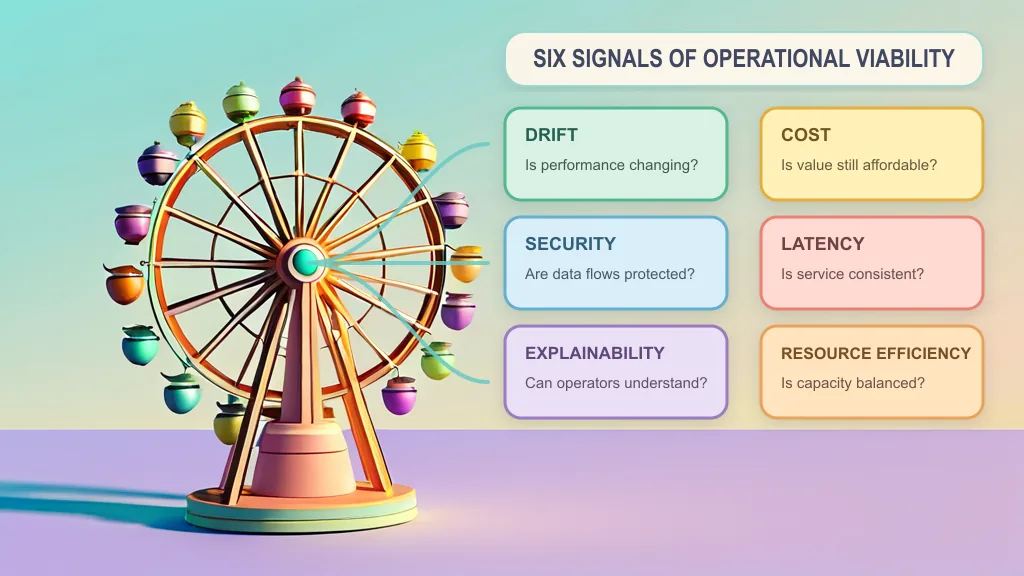
Do not ask teams to operate what the enterprise has not funded and designed to support. The transition from experimentation to production is not a technical upgrade; it is an organizational shift. It requires moving from asking “Can we build this?” to “Can we sustainably govern this?” Six operational signals help determine whether an AI system is ready for daily use.
Day Two depends on monitoring that drives action, a shared platform operating model, and the minimum governance needed to move beyond experiments.
The Six Signals of Operational Viability
To move beyond the pilot phase, organizations must monitor specific metrics that indicate true readiness. These are not vanity numbers but critical indicators of systemic health.
Signal One: Drift Velocity
Model performance can change as data, users, prompts, dependencies, or the environment change. The first signal is the direction and speed of that change against a use-case-specific tolerance. A breach of the tolerance should trigger investigation, not an automatic assumption that retraining is the answer. The cause may be the data pipeline, a model update, retrieval quality, or a change in the business process itself.
Signal Two: Cost Per Outcome
Pilot projects often hide costs, but production systems expose them immediately. The second signal is the cost-to-value ratio of every inference. Is the expense of running the model outweighing the value it delivers to the business process? Without continuous capacity planning, costs will spiral as usage grows or data complexity increases. Organizations must track marginal costs and ensure they remain within budget constraints without sacrificing performance.
Signal Three: Security Posture
Generative AI introduces unique vectors for prompt injection, data leakage, and adversarial attacks. The third signal is the integrity of the input and output streams. Does the system effectively sanitize inputs before processing? Are outputs validated to prevent sensitive information from leaking into public-facing applications? Security cannot be a post-hoc check; it must be embedded in the inference loop.
Signal Four: Latency Consistency
User experience depends on the response-time distribution, not only the average. The fourth signal is latency variance under load. During peak periods or resource contention, does the service remain within the use case’s acceptable range? A drafting assistant can tolerate a different delay from an interactive support or operational workflow, so measure the threshold users actually experience.
Signal Five: Explainability Depth
Black-box models are dangerous in regulated environments and confusing for end-users. The fifth signal is the ability to explain decisions with sufficient depth for human oversight. Can operators understand why a specific recommendation was made? Without explainability, teams cannot debug failures or build confidence in the system’s logic.
Signal Six: Resource Efficiency
The final signal is how well the system utilizes underlying compute resources. Is it over-provisioned, leading to wasted spend, or under-provisioned, risking performance degradation? Workload optimization requires dynamic scaling that matches actual demand patterns rather than static baselines set during the pilot phase.
The Readiness Scorecard
To make these signals actionable, use a production-readiness scorecard. Do not average away a critical failure. Define a minimum acceptable condition for every signal, identify which conditions are release blockers, and record who can accept an exception. A system advances when it meets the use case’s gates, not when an arbitrary composite score looks healthy.
| Signal | Metric Target | Status Indicator |
|---|---|---|
| Drift Velocity | < 5% accuracy drop per month | Stable / Degraded |
| Cost Per Outcome | Within budget variance of ±10% | Optimized / Bleeding |
| Security Posture | Zero high-severity incidents | Secure / At Risk |
| Latency Consistency | < 20% variance at peak load | Reliable / Unstable |
| Explainability Depth | Full audit trail available | Transparent / Opaque |
| Resource Efficiency | Utilization > 60% and < 85% | Balanced / Inefficient |
This scorecard transforms abstract concerns into concrete decisions. It forces teams to confront the reality that a working prototype is not a finished product. If the system cannot meet these standards, it does not belong in operations.
Service Ownership and Accountability
A major hurdle in scaling AI is the ambiguity of service ownership. Unlike traditional software where code lives in repositories and deployments are predictable, AI systems evolve continuously. Who owns the model when data changes? Who is responsible for the cost when usage spikes unexpectedly? The answer lies in clear accountability structures that align with business outcomes rather than technical silos.
Leadership must define specific roles for data stewards, model owners, and outcome managers. Data stewards ensure the quality of inputs; model owners manage performance and drift; outcome managers track value and cost. Without this division of responsibility, teams become bogged down in cross-functional disputes that stall progress. The goal is to create a culture where every stakeholder understands their role in maintaining system health.
This structure also clarifies who must step in when things go wrong. In many organizations, the fear of blame leads to hiding failures rather than addressing them. A healthy operating model embraces failure as a learning opportunity but requires clear protocols for containment and remediation. Teams should be empowered to fix issues without waiting for permission, provided they follow established safety rails.
Retirement and Rollback Criteria
Deployment criteria need a counterpart: conditions for pausing, rolling back, redesigning, or retiring the system. Those conditions should reflect the use case. Quality drift may justify routing work to a human, a cost increase may trigger model or workflow review, and a control failure may require an immediate stop. Retirement also needs an owner, because an unused endpoint, data pipeline, or credential can outlive the product that created it.
Retirement Criteria: A system becomes a retirement candidate when it repeatedly misses its outcome or control thresholds, when its fully loaded cost no longer compares favorably with the alternative, or when a critical data or model dependency can no longer be trusted. The review period should match the business process. A seasonal planning model and a real-time customer workflow should not share the same clock.
Rollback Criteria: Rollback design should match the action’s reversibility. Some failures justify an automatic stop or a return to a known model version. Others require routing work to a manual process, limiting a feature, or isolating a dependency while investigation continues. Define those paths before launch and test that the people expected to use them can actually do so.
These criteria prevent the illusion of progress where a system looks good on paper but fails in practice. They ensure that resources are focused on systems that deliver value and reduce risk rather than those that merely exist.
Fund the Service You Intend to Run
The NIST AI Resource Center emphasizes testing, evaluation, verification, and validation in operationalizing the AI Risk Management Framework. Those activities require owners, time, data, and tooling. They are part of the service cost, not optional paperwork after launch.
If leadership will not fund telemetry, evaluation, security review, dependency management, support coverage, and a fallback path, the system is not ready for production. That does not mean every experiment needs production-grade machinery. It means the commitment should grow with the blast radius. Start small, make the operational signals visible, and expand only when the team can demonstrate that the system remains useful, supportable, and economically defensible under real demand.