Seat counts can describe part of an AI budget, but they cannot explain its economics. Enterprise AI spending changes with model choice, workload demand, context size, infrastructure, quality controls, and the human work required to turn an output into something useful. The better model is a dynamic unit-cost system tied to business outcomes.
This shift requires moving from asking “How many tokens did we use?” to “What value did those tokens generate?” Without this reframing, organizations risk building expensive infrastructure that delivers negligible returns while leaving critical capabilities under-resourced. The goal is not to conquer technology for its own sake but to optimize for enterprise outcomes, ensuring every dollar spent reduces meaningful risk or improves operational capability.
The economic model rests on the same foundations described in why enterprise AI depends on infrastructure, platform engineering as a shared capability, and measured capacity signals.
The Budget Trap and the Shift to Unit Economics
Many software budgets start with a predictable license or capacity commitment. Generative AI can behave differently: two workflows with the same number of users may have very different inference, retrieval, storage, evaluation, and support costs. Longer context, more capable models, repeated retries, and higher assurance requirements can all change the bill. A seat-based forecast hides those differences.
The core issue is the gap between technology usage and business value. When teams purchase capacity without understanding the marginal cost per useful outcome, infrastructure efficiency can improve while the business case gets worse. That is a portfolio problem, not merely a billing problem.
To fix this, we must adopt a FinOps mindset that ties technology usage directly to business value. As the FinOps Foundation outlines, effective management requires timely data, shared ownership between finance and engineering, and rigorous allocation strategies. This means treating AI not as a commodity but as a variable cost that fluctuates based on demand and output quality. The organization must move from forecasting seat counts to forecasting token utilization and outcome delivery.
A Four-Part Cost Model for Enterprise AI
To manage these volatile costs effectively, leaders need a structured framework that goes beyond simple monitoring. Drawing on established FinOps principles, we can build a four-part cost model that captures the nuances of AI economics:
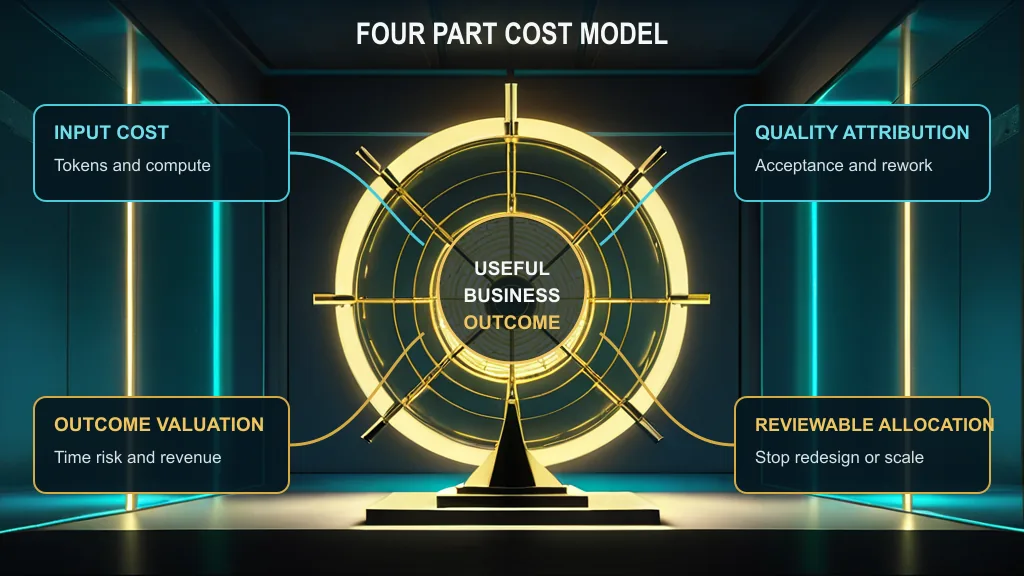
- Input Cost Tracking: Monitor raw token consumption and compute hours across different models. This provides the granular data needed to understand baseline efficiency but is insufficient on its own because it lacks context regarding output quality.
- Quality Attribution: Measure whether the workflow reaches its acceptance threshold and how much review or rework it creates. More model consumption can be rational when it materially improves a valuable outcome; cheap output that people cannot use is still waste.
- Outcome Valuation: Assign monetary value to specific business outcomes generated by AI, such as time saved, errors prevented, or revenue generated. This step is critical for distinguishing between cost per token and cost per useful outcome.
- Reviewable Allocation: Use current demand, cost, quality, and outcome data to revisit resource allocation at a defined cadence. A weak result should trigger investigation and a stop, redesign, or scale decision, not an automatic shutdown based on one noisy metric.
This model gives teams a way to explain where cost enters the system and which lever they can change. It also makes capacity planning and financial forecasting more honest because the assumptions remain visible.
Distinguishing Cost Per Token From Cost Per Outcome
A common pitfall in early AI adoption is focusing solely on cost per token. The metric is useful for comparing parts of an inference stack, but it says little about whether the output completed useful work. A workflow can be cheap per request and still be expensive after retries, review, correction, and rework. A more costly request can be the better choice when it reliably avoids those downstream costs.
The distinction lies in the denominator: measure useful outcomes rather than processed inputs. For a contract-review aid, useful measures might include completed reviews, cycle time, issues correctly surfaced, false positives, and reviewer effort. Human review is part of the design for consequential legal work, not an unexpected exception. Its cost belongs in the unit economics.
This changes the scaling conversation. Faster generation helps only when the additional output is useful at an acceptable risk and review cost. Leaders should ask product, engineering, finance, and risk teams to agree on that denominator before infrastructure utilization or token efficiency becomes the headline metric.
The Build/Buy/Place Tradeoff in an Uncertain Market
Enterprise AI introduces a new layer of complexity to the traditional build/buy/place tradeoff. Historically, companies chose between developing proprietary software, purchasing off-the-shelf solutions, or outsourcing work. With AI, these options now involve significant variable costs and risk profiles that were previously unknown.
The decision now includes model ownership versus managed services, committed infrastructure versus elastic consumption, and the controls required in each environment. NIST’s AI Risk Management Framework organizes risk work into Govern, Map, Measure, and Manage. Its lifecycle approach is also a reminder that economic assumptions need review as demand, models, controls, and outcomes change.
For instance, owning more of the model and infrastructure stack can improve control or unit cost at sufficient, predictable volume, but it also creates engineering, capacity, security, and lifecycle obligations. A managed model service can reduce the initial commitment and absorb demand swings, while making price, rate limits, and provider changes part of the operating risk. Neither option wins in the abstract. The relevant question is which cost and control profile fits the outcome and its uncertainty.
Model and platform decisions also need portfolio discipline. Standardization can improve purchasing leverage, skills, and control coverage. Deliberate exceptions can improve outcome quality or reduce cost for a particular workload. The executive job is to make that tradeoff visible, including the operational price of every additional platform, rather than letting departmental preferences quietly become enterprise architecture.
Stop-or-Scale Gates and Portfolio Decisions
Experiments can continue consuming money after they have stopped producing useful evidence. Stop-or-scale gates create a scheduled decision point adapted to AI economics.
A stop gate triggers when the cost per useful outcome exceeds a predefined threshold or when quality metrics degrade beyond acceptable limits. This prevents teams from continuing to spend resources on tasks that do not generate value. A scale gate activates when demand outstrips current capacity and the marginal cost remains within the budget, allowing the project to grow only if it continues to meet business objectives.
These gates require robust data and shared ownership between finance, operations, and product teams. They force a rigorous review of whether the technology is actually solving the problem or merely automating inefficiency. By integrating these gates into the operational model, leaders can ensure that resources are concentrated on high-impact initiatives while quickly cutting losses from underperforming ones. This approach aligns with the broader goal of optimizing for enterprise outcomes rather than protecting a specific technology stack.
Make the Portfolio Review Earn Its Keep
The leadership challenge is to resist optimizing the technology in isolation. Ask three questions at every review: What useful outcome are we buying? What is its fully loaded unit cost? What new evidence would make us scale, change course, or stop?
Those questions will not produce perfect forecasts. They will expose assumptions early enough to make a decision, which is far more valuable than a precise token budget attached to the wrong denominator.